
Search Articles
Browse Content (p. 170)

Article
Parmenides & the Path of Truth
Parmenides (l. c. 485 BCE) lived and taught in Elea, a Greek colony in southern Italy and is known as the founder of the Monist School (though it may have been founded by Xenophanes of Colophon, l. c. 570-478 BCE...

Article
From Slavery to Freedom: Epictetus' Path
The Stoic philosopher Epictetus (l.c. 50- 130 CE) following the example of Socrates, wrote none of his teachings down, preferring to impart his wisdom to his students through class discussions. His student...

Article
Xenophanes the Visionary Poet Philosopher
Xenophanes of Colophon (l.c. 570-c.478 BCE) is known as one of the Pre-Socratic philosophers of ancient Greece, so-called because they pre-date Socrates (l. c. 470/469-399 BCE), recognized as the Father of...

Article
The Phoenician Alphabet & Language
Phoenician is a Canaanite language closely related to Hebrew. Very little is known about the Canaanite language, except what can be gathered from the El-Amarna letters written by Canaanite kings to Pharaohs Amenhopis...

Article
The Cyrus Cylinder
The Cyrus Cylinder is a document issued by Cyrus the Great, consisting of a cylinder of clay inscribed in Akkadian cuneiform script. The cylinder was created in 539 BCE, surely by order of Cyrus the Great, when he took Babylon...

Article
Some new hypotheses on the problems of the Indo-Greek kingdoms
Warning: See the definitions of Greco-Bactrian and Indo-Greek Kingdoms before reading this article, otherwise the following lines could give you serious headaches! A lack of information is...

Article
The Hypaspists in Ancient Sources
Hypaspist translitterates the Greek term meaning shield-bearer, or armour-bearer (ὁ ὑπασπιστής). This noun is formed from the verb ὑπασπίζειν - to carry the shield for another; serve as a shieldbearer. The Shieldbearers...
Article
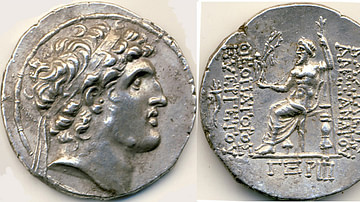
Alexandros I Balas
Alexandros I Balas was a Seleucid king from 152 BC to 145 BCE. As the Seleucid king Demetrius I Soter (162-150 BCE) became more and more unpopular due to his arrogance and drunkenness, it was quite an easy task for the rival...

Article
Epona
Epona was a Celtic goddess. Her name contains an allusion to the horse: in Celtic, "epos" means “horse” and the suffix “-ona” affixed simply means “on”. Epona is the patron goddess of mares and foals. The oldest information about the...

Article
Hesiod on the Birth of the Gods
The Greek poet Hesiod (c. 700 BCE) is most famous for his works Theogony and Works and Days. In this passage from Theogony, Hesiod relates the birth of the gods from cosmic Chaos and follows the lineage through the...
