

 2
2
This text is available in other languages:

The rise of the Huns in the 5th century CE reshaped the political landscape of Late Antiquity, culminating under Attila the Hun (reign 434-453 CE). Emerging from the Eurasian steppe, the Huns did not form a centralized territorial state in the Roman sense but rather a flexible sphere of dominance built on tribute, alliance, and coercion. Their expansion placed sustained pressure on both the Eastern and Western Roman Empires, forcing costly payments and exposing the vulnerabilities of imperial frontiers. Hunnic power also accelerated wider population movements, contributing to the shifting configurations of post-Roman Europe.
Attila’s campaigns between 441 and 452 CE illustrate both the reach and the limits of Hunnic power: major incursions into the Balkans imposed tribute on Constantinople, while offensives into Gaul (451 CE) and Italy (452 CE) demonstrated strategic mobility but failed to secure lasting conquest. Rather than establishing durable administrative control, Hunnic authority depended on personal leadership and the cohesion of allied groups. Following Attila’s death in 453 CE, this system rapidly fragmented, and subject peoples reasserted independence.
About the Author
Related Images

Empire of Attila the Hun

Attila the Hun by Delacroix

Army of Attila the Hun

Attila the Hun Bust

Bust of Attila the Hun
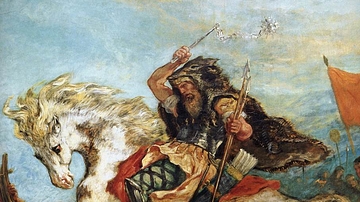
Attila the Hun in Battle
Cite This Work
APA Style
Netchev, S. (2026, May 06). Map of the Empire of the Huns under Attila, c. 450 CE: Power, Pressure, and Collapse in Late Antiquity. World History Encyclopedia. https://www.worldhistory.org/image/21771/map-of-the-empire-of-the-huns-under-attila-c-450-c/
Chicago Style
Netchev, Simeon. "Map of the Empire of the Huns under Attila, c. 450 CE: Power, Pressure, and Collapse in Late Antiquity." World History Encyclopedia, May 06, 2026. https://www.worldhistory.org/image/21771/map-of-the-empire-of-the-huns-under-attila-c-450-c/.
MLA Style
Netchev, Simeon. "Map of the Empire of the Huns under Attila, c. 450 CE: Power, Pressure, and Collapse in Late Antiquity." World History Encyclopedia, 06 May 2026, https://www.worldhistory.org/image/21771/map-of-the-empire-of-the-huns-under-attila-c-450-c/.
