


Ibn Battuta (Abū Abd Allāh Muḥammad ibn Abd Allāh Al-Lawātī, 1304–c.1368 CE) was a 14th-century Maghrebi traveler, scholar, and judge whose journeys across the Islamic world and beyond remain among the most remarkable in history. Over a span of nearly thirty years, he covered approximately 75,000 miles (120,000 kilometers), visiting North and West Africa, the Middle East, Persia, Central Asia, India, Southeast Asia, and China. His travels reflected both the vast interconnectedness of the Islamic world under Mongol and post-Mongol rule and the personal devotion of a Muslim jurist seeking knowledge and adventure within the framework of Dar al-Islam (“the Abode of Islam”).
After his return to Morocco, Ibn Battuta dictated his experiences to the scholar Ibn Juzayy, resulting in The Rihla (“The Journey”)—a monumental travelogue that serves as one of the most comprehensive ethnographic records of the medieval Afro-Eurasian world. His accounts reveal the economic systems, governance, and cultural practices of the regions he visited, from the Malian Empire and Delhi Sultanate to the Yuan dynasty in China. While parts of his narrative may blend observation with embellishment, The Rihla remains an invaluable primary source for understanding the complexity, diversity, and interconnectedness of the 14th-century world.
About the Author
Related Images
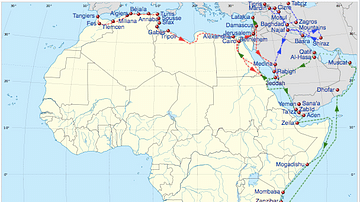
Map of Ibn Battuta's Travels, 1325-32 CE
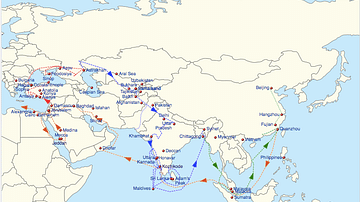
Map of Ibn Battuta's Travels, 1332-47 CE

Map of the Trade Networks in the Middle Ages, c. 1200

Map of the Mamluk Sultanate of Egypt c. 1330 - Slave Soldiers Who Ruled an Empire

Map of the Rise of the Delhi Sultanate: The Mamluk Period - From Slave Commanders to Sultans

Map of the Trade in the Indian Ocean 15th-16th century - From Afro-Asian Exchange to European Intervention
External Links
Cite This Work
APA Style
Netchev, S. (2024, May 09). Map of Ibn Battuta’s Travels, 1325-1354. World History Encyclopedia. https://www.worldhistory.org/image/18929/map-of-ibn-battutas-travels-1325-1354/
Chicago Style
Netchev, Simeon. "Map of Ibn Battuta’s Travels, 1325-1354." World History Encyclopedia, May 09, 2024. https://www.worldhistory.org/image/18929/map-of-ibn-battutas-travels-1325-1354/.
MLA Style
Netchev, Simeon. "Map of Ibn Battuta’s Travels, 1325-1354." World History Encyclopedia, 09 May 2024, https://www.worldhistory.org/image/18929/map-of-ibn-battutas-travels-1325-1354/.
