
Search
Remove Ads
Advertisement
Search Results

Definition
Byzantine Coinage
The coinage of the Byzantine Empire continued that of its more ancient predecessors and functioned as a convenient method of payment for goods and services, especially to soldiers and officials, and as a means for people to pay...

Definition
Flann Sinna
Flann Sinna (r. 879-916 CE) was a High King of Ireland from the Kingdom of Mide (Meath) and a member of the Clann Cholmain, a branch of the Southern Ui Neill dynasty. His name is pronounced “Flahn Shinna” and means “Flann of the Shannon”...

Definition
Ancient Celtic Art
Art, along with language, is perhaps the best way to see the connections between the ancient peoples we label as Celts who lived in Iron Age Europe. There were great variations across time and space but common features of ancient...

Definition
Idunn
Idunn (pronounced Ih-dune) is a fertility goddess in Norse mythology who holds the apples of eternal youth the gods rely on to remain young and healthy. The Norse gods were not immortal – they just lived very long lives – and the apples...

Definition
Nicodemus
Nicodemus was an early follower of Jesus Christ, uniquely mentioned only in the fourth gospel, the Gospel of John. According to that gospel, he was a Pharisee and a member of the Sanhedrin (the Jewish Council) in Jerusalem at the time...

Definition
Valhalla
Valhalla ("Hall of the Slain") is the afterlife realm in Norse mythology for fallen heroes selected by Odin’s Valkyrie to become members of the army that will fight against the forces of chaos at Ragnarök. The concept of Odin’s Hall...

Definition
Easter
Easter is the Christian holiday that celebrates the resurrection of Jesus of Nazareth three days after he died from crucifixion by the Roman magistrate Pontius Pilate (c. 30 CE). Easter Sunday is the culmination of the week-long events...
Definition
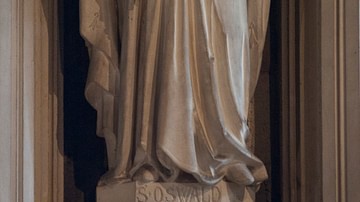
Oswald of Northumbria
Oswald of Northumbria (c. 604 - c. 642 CE) was a 7th-century Anglo-Saxon king and saint. He came to power in Northumbria c. 633 or 634 CE following his victory over Cadwallon ap Cadfan, King of Gwynedd. Oswald ruled over the...
Definition
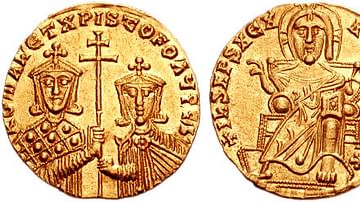
Romanos I
Romanos I Lekapenos (“the Ignorant”) was emperor of the Byzantine Empire from 920 to 944 CE. Of Armenian descent, he was a military commander who usurped the throne to rule as co-emperor with the rightful heir, but still minor, Constantine...

Definition
Hilda of Whitby
Hilda of Whitby (also known as Saint Hilda of Whitby, l. 614-680 CE) was the founder and abbess of the monastery at Whitby, Kingdom of Northumbria, Britain. She was a Northumbrian princess who converted to Christianity with the...
