
Search
Remove Ads
Advertisement
Search Results

Article
The Sun & the Moon in Norse Myth
In Norse mythology, the Sun and the Moon appear as personified siblings pulling the heavenly bodies and chased by wolves, or as plain objects. Written sources, such as the Poetic Edda and the Prose Edda, have surprisingly...
Article
Exploring Norways' Forgotten Stone Circles & Petroglyphs
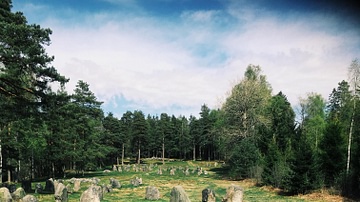
Right outside the cities of Fredrikstad and Sarpsborg in South-East Norway, there are two archaeological, intriguing and beautiful sites, the Hunnfelt, a monument consisting of several stone circles...

Video
The Nine Realms of Norse Cosmology
The Norse people in their mythology divided their universe into nine realms with the world tree, Yggdrasil, in the centre. From Yggdrasil the nine realms of their cosmology either spread out from it or they stretched...
Image
The Holy Island of Lindisfarne
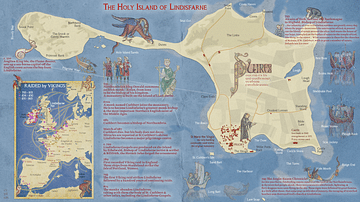
A map illustrating the geography and history of Holy Island, also known as Lindisfarne. A tidal island off the northeast coast of England in Northumberland, it holds significant historical and religious importance...

Image
Qilakitsoq Mummies
The Inuit mummies of Qilakitsoq, Greenland, are about 500 years old and were found in Greenland in 1972. Eight mummies were found: three older women, three younger women, and two small boys.
Greenland National Museum, Nuuk.

Definition
Valhalla
Valhalla ("Hall of the Slain") is the afterlife realm in Norse mythology for fallen heroes selected by Odin’s Valkyrie to become members of the army that will fight against the forces of chaos at Ragnarök. The concept of Odin’s Hall...

Definition
Easter
Easter is the Christian holiday that celebrates the resurrection of Jesus of Nazareth three days after he died from crucifixion by the Roman magistrate Pontius Pilate (c. 30 CE). Easter Sunday is the culmination of the week-long events...
Definition
Oswald of Northumbria
Oswald of Northumbria (c. 604 - c. 642 CE) was a 7th-century Anglo-Saxon king and saint. He came to power in Northumbria c. 633 or 634 CE following his victory over Cadwallon ap Cadfan, King of Gwynedd. Oswald ruled over the...
Definition
Romanos I
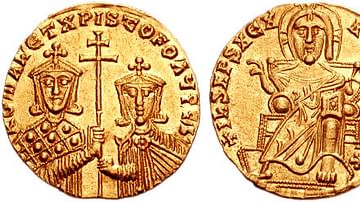
Romanos I Lekapenos (“the Ignorant”) was emperor of the Byzantine Empire from 920 to 944 CE. Of Armenian descent, he was a military commander who usurped the throne to rule as co-emperor with the rightful heir, but still minor, Constantine...

Definition
Hilda of Whitby
Hilda of Whitby (also known as Saint Hilda of Whitby, l. 614-680 CE) was the founder and abbess of the monastery at Whitby, Kingdom of Northumbria, Britain. She was a Northumbrian princess who converted to Christianity with the...
