
Search
Did you mean: Uxmal?
Remove Ads
Advertisement
Search Results

Definition
Sumer - The Cradle of Civilization
Sumer was the southernmost region of ancient Mesopotamia (modern-day southern Iraq and parts of Kuwait), which has long been considered the cradle of civilization. The name comes from Akkadian, the language of the...

Definition
Nisaba - Sumerian Goddess of Writing and Scribe of the Gods
Nisaba (also Naga, Se-Naga, Nissaba, Nidaba, and associated with Nanibgal) is the Sumerian goddess of writing, accounts, and scribe of the gods. Although her name is commonly given as Nidaba...

Definition
Quran
The Quran (also written Qur’an or Koran), revealed in the 7th century, is the sacred book of Islam, following in the tradition of the Abrahamic faiths, with the Torah as the sacred book of Judaism and the New Testament as the sacred book...

Definition
Mesopotamian Naru Literature - The World's First Historical Fiction
Mesopotamian Naru Literature was a literary genre, first appearing around the 2nd millennium BCE, which featured a famous person (usually a king) from history as the main character in a...

Article
Trade in Ancient Mesopotamia - How Commerce Encouraged Civilization
Local trade in ancient Mesopotamia began in the Ubaid period (circa 6500-4000 BCE), had developed into long-distance trade by the Uruk period (circa 4000-3100 BCE), and was flourishing by...

Article
Sargon and Ur-Zababa - Two Dream Visions and a River of Blood
Sargon and Ur-Zababa is a Sumerian poem, date of composition unknown, relating the rise to power of Sargon of Akkad (reign 2334-2279 BCE), founder of the Akkadian Empire. The work is classified...

Article
Truths Wrapped in Fiction: Mesopotamian Naru Literature - Originality in Writing Ancient Bestsellers
Originality in literary compositions in the ancient world did not carry the same weight and value as it does today. In recent centuries, authors have been applauded...

Image
The Kish Tablet - And the Earliest Evidence of Writing
The Kish Tablet, illustration by José-Manuel Benito, July 2006. The Kish Tablet, from Tell al-Uhaymir, Iraq, is among the oldest known inscriptions using proto-cuneiform symbols. Before this, writing...
Image
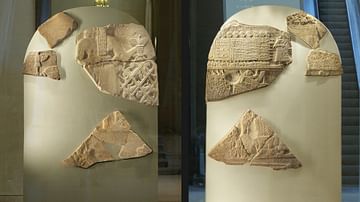
Stele of the Vultures
Stele of the Vultures fragments, dated to the Early Dynastic III Period (2600-2334 BCE), commemorating the victory of the city of Lagash over Umma.
Louvre, Paris.

Image
Battle Scene from Stele of the Vultures c. 2600 BCE
The Battle Scene from the Stele of the Vultures, created to commemorate the victory of Lagash over Umma c. 2600 BCE.
Louvre, Paris.
