
Search
Did you mean: Uxmal?
Remove Ads
Advertisement

 This answer was generated by
 Search Results
Image
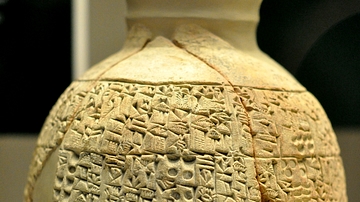
Vessel from Umma
"This is the boundary according to the monument of (the god) Shara". This is the historical cuneiform text on this vessel, which gives the city of Umma's account of its long-running border dispute with Lagash. Early Dynastic III...

Definition
Mesopotamian Warfare - Early Development of Armed Conflict
Ancient Mesopotamian warfare progressed from companies of a city's militia in Sumer to the professional standing armies of Akkad, Babylon, Assyria, and Persia, and from conflicts over land or water...

Article
Geme-Suen v Ur-Lugal's Wife - A Court Case in Ancient Mesopotamia
During the 21st century BCE, an era known as the Ur III period in Mesopotamia, many records of court hearings were drawn up in Umma, a city in what is now southern Iraq. One court record...

Definition
Early Dynastic Period in Mesopotamia - Era of Many of the "Firsts" in Civilization
The Early Dynastic period in Mesopotamia is the modern-day archaeological term for the era in Mesopotamian history – circa 2900 to circa 2350/2334 BCE – during which some of...

Definition
Sargon of Akkad - From Gardener to King of the Four Corners of the World
Sargon of Akkad (reign 2334-2279 BCE) was the king of the Akkadian Empire of Mesopotamia, the first multinational empire in history, who united the disparate kingdoms of the region under...

Definition
Kish - The First City of Political Prominence in History
Kish was one of the most significant and politically prestigious city-states in ancient Mesopotamia. According to the Sumerian King List, it was the first city to be given divine kingship after...

Article
Women in Ancient Mesopotamia - Celebrating the Feminine Principle in the Near East
The lives of women in ancient Mesopotamia cannot be characterized as easily as with other civilizations, owing to the different cultures over time. Generally speaking, though...

Article
The Battle of Kadesh & the First Peace Treaty
Ramesses II (The Great, 1279-1213 BCE) ruled Egypt for 67 years and, today, the Egyptian landscape still bears testimony to the prosperity of his reign in the many temples and monuments he had built in...

Article
Ten Great Ancient Mesopotamian Women - Monarchs, Generals, and Scribes
The lives of women in ancient Mesopotamia were regulated by a patriarchal hierarchy, but within this social structure, there were many who distinguished themselves and some who were able...

Image
Map of Lugalzagesi's Domains
A map of the Kingdom of king Lugalzagesi of Umma, circa 2350 BC.
