
Search
Remove Ads
Advertisement
Search Results

Definition
Hellenistic Astrology
Hellenistic astrology encompassed various forms of divination in Greece and the Mediterranean, all linked to the observation of astronomical phenomena. Hellenistic astrology was based on the belief that the stars and planets...

Definition
Ostia
Ostia (or Ostia Antica) lies 15 km from the city of Rome for which it served as the city's principal port and harbour throughout antiquity. The name derives from 'os' or 'ostium' which means 'mouth' and refers to the city's location at...

Definition
Giovanni Boccaccio
Giovanni Boccaccio (1313-1375) was an Italian poet, writer, and scholar. His most famous and influential work is the Decameron, completed by 1353, in which his ten characters present 100 tales of everyday life. The book covers...

Image
The Columbian Exchange - Global Connections and Consequences after 1492
The Columbian Exchange (from 1492 CE) refers to the large-scale transfer of plants, animals, diseases, peoples, and technologies between the Americas and Afro-Eurasia following the transatlantic...

Video
Trade in Ancient Greece
In the video below, Museum of Fine Arts curator Phoebe Segal explains how ancient coins tell us about the trade routes and economic patterns of their time. For more CitiesX content, sign-up for the course on edX: https://www.edx.org/course/citiesx-past-present-future-urban-life-harvardx-urban101x...

Article
7 Ancient Sites in Georgia
Georgia, lying at the junction of Europe and Asia, is a country of ancient myths with a rich and turbulent history. Home to the first European hominids and the birthplace of wine, Georgia's roots trace back to ancient...

Definition
Herakleia Lynkestis
Herakleia Lynkestis (Heraclea Lyncestis; Ἡράκλεια Λυγκηστίς) was a city in the ancient kingdom of Macedon not far from modern Bitola, founded c. 358 BCE by Philip II of Macedon (r. 359-336 BCE) as a governing centre for his...
Definition
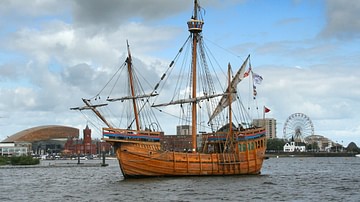
Caravel
The caravel (caravela in Spanish and Portuguese), was a type of medium-sized ship which, with its low draught and lateen or triangular sails, made it ideal for exploration from the 15th century onwards. Fast, manoeuvrable, and only needing...

Definition
Sundiata Keita
Sundiata Keita (aka Sunjaata or Sundjata, r. 1230-1255) was the founder of the Mali Empire (1240-1645) in West Africa. A prince of the Malinke tribe, Sundiata would not only overthrow the rule of the kingdom of Sosso (c. 1180-1235...

Article
North Africa’s Place in the Mediterranean Economy of Late Antiquity
The Mediterranean Sea was the economic focal point of the Roman Empire. Rome's armies first established an empire across these waters beginning back in the times of the Roman Republic...
