
Search
Did you mean: Tomb?
Remove Ads
Advertisement
Search Results

Article
Illyria - Exploring Ancient Albania
Albania is located at the crossroads of the eastern Adriatic and was known as Illyria and Epirus throughout the Classical era. It played a strategic role in ancient times and was a point of contact between Illyrian...

Article
Parthian-Scythian Relations
While little is written about Parthian-Scythian relations, not only did the Parthians share origins with the Scythians and cooperated militarily but social, cultural, and commercial interactions were likely as well. Essentially...

Article
Celtic Brooches - The Jewellery of the Ancient Celts
Ancient and medieval Celtic cultures produced many forms of jewellery, and one distinctive category is their brooches, fibulae, and pins. Without zips and buttons, brooches were used to close items...

Article
Turquoise in Mesoamerica
Turquoise was a highly-prized material in ancient Mesoamerica, perhaps the most valued of all materials for sacred and decorative art objects such as masks, jewellery, and the costumes of rulers and high priests. Turquoise...

Article
7 Ancient Sites in Georgia
Georgia, lying at the junction of Europe and Asia, is a country of ancient myths with a rich and turbulent history. Home to the first European hominids and the birthplace of wine, Georgia's roots trace back to ancient...
Article
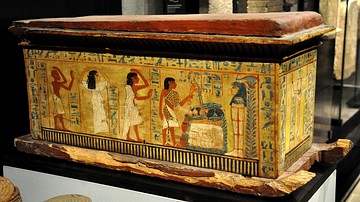
The Egyptian Afterlife & The Feather of Truth
Is it possible to have a heart that is lighter than a feather? To the ancient Egyptians it was not only possible but highly desirable. The after-life of the ancient Egyptians was known as the Field of Reeds...
Article
Ancient Egyptian Medicine: Study & Practice
In Europe, in the 19th century CE, an interesting device began appearing in graveyards and cemeteries: the mortsafe. This was an iron cage erected over a grave to keep the body of the deceased safe from 'resurrectionists'...

Article
Justinian's Plague (541-542 CE)
During the reign of the emperor Justinian I (527-565 CE), one of the worst outbreaks of the plague took place, claiming the lives of millions of people. The plague arrived in Constantinople in 542 CE, almost a year...
Article
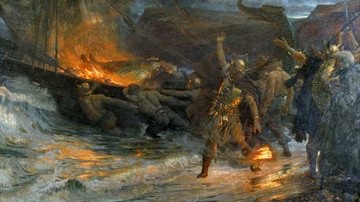
Norse Ghosts & Funerary Rites
In Norse belief, the soul of the deceased might wind up in any one of a number of afterlife realms. There was Valhalla, the realm of Odin where the dead warriors drank, fought, and told stories, Folkvangr ('the Field...

Article
Religion in the Mongol Empire
The Mongol Empire (1206-1368 CE) covered Asia from the Black Sea to the Korean peninsula and so naturally included all manner of religions within its borders, but the Mongols themselves had their own particular religious...
