
Search
Remove Ads
Advertisement
Search Results
Article
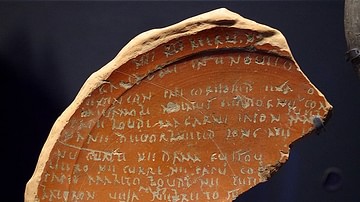
A Linguistical Analysis of Ancient Celtic Languages
The Celtic languages form a branch of the Indo-European (IE) language family. They derive from Proto-Celtic and are divided into Continental Celtic languages (Lepontic, Gaulish, Galatian, Noric, Celtiberian...
Definition
Nehushtan
According to the Bible, Nehushtan was a metal serpent mounted on a staff that Moses had made, by God's command, to cure the Israelites of snake bites while wandering in the desert. The symbol of snakes on a staff or pole is a motif...

Article
Burial in Ancient Mesopotamia - Respect for the Living, Honoring the Dead
Burial in ancient Mesopotamia was the practice of interring a corpse in a grave or tomb while observing certain rites, primarily to ensure the passage of the soul of the deceased to...

Article
Chariots in Ancient Indian Warfare
The chariot was the elite arm of ancient Indian armies in the Vedic (1500 BCE – 1000 BCE) and Epic periods (described by the Ramayana and the Mahabharata, 1000-600 BCE) because of the advantages it conferred and...

Image
Twelve Spices That Changed the World - Trade, Empire, and the Global Age of Spices, 1450–1650
Between c. 1450 and 1650, demand for spices and other high-value plant commodities became an important catalyst for European maritime expansion. Pepper, cinnamon, cloves...

Article
Games, Sports & Recreation in Ancient Egypt
Although the ancient Egyptians are often depicted as death-obsessed and dour, they actually had a great appreciation for life and their culture reflected their belief in existence as an eternal journey imbued...

Image
Map of the World According to Christopher Columbus, c. 1490 - How Columbus Misjudged the Distance to Asia
The geographical worldview of Christopher Columbus (1451–1506) reflected a combination of classical geography, medieval cosmography, and European knowledge...

Image
Map of the World from Sippar, Mesopotamia
This tablet contains both a cuneiform inscription and a unique map of the Mesopotamian world. Babylon is shown in the center (the rectangle in the top half of the circle), and Assyria, Elam and other places...

Image
Map of the Norman World, c. 1130 - From Viking Settlers to a Trans-Mediterranean Networks
The Norman world (c. 10th–13th centuries CE) was not a single unified empire, but a far-reaching network of Norman-ruled principalities, kingdoms, military expeditions...

Image
10 Women Scientists Who Changed the World - Discoveries That Transformed Science and Medicine
Throughout history, women in science have made groundbreaking discoveries, often pushing the boundaries of knowledge despite being overlooked and underrecognized. Many...
