
Search
Remove Ads
Advertisement
Search Results

Article
The Five Gifts of Hathor: Gratitude in Ancient Egypt
The central cultural value of ancient Egypt was ma'at – harmony and balance – which maintained the order of the universe and the lives of the people. Keeping balance in one's life encouraged the same...

Article
Dogs & Their Collars in Ancient Greece
Dogs in ancient Greece are regularly depicted in art, on ceramics, in literature, and other written works as loyal companions, guardians, hunters, and even as great intuitive thinkers; all of these expressing...

Article
Dogs and Their Collars in Ancient Mesoamerica
Dogs were an integral aspect of the lives of the people of Mesoamerica regardless of their location or culture and, throughout the region, were recognized as liminal beings belonging not only to the natural...

Article
Religion in Ancient China
Religious practices in ancient China go back over 7,000 years. Long before the philosophical and spiritual teachings of Confucius and Lao-Tzu developed or before the teachings of the Buddha came to China, the people worshipped...

Article
Music & Dance in Ancient Egypt
Music and dance were highly valued in ancient Egyptian culture, but they were more important than is generally thought: they were integral to creation and communion with the gods and, further, were the human response...

Article
Ancient Celtic Society
The society of the Celts in Iron Age Europe was made up of several distinct hierarchical groups. At the top were rulers and elite warriors, then there were the religious leaders, the druids, and then specialised craftworkers...

Article
Inventions & Innovations of Ancient Persia
Ancient Persian culture contributed many of the aspects of the modern world which people take for granted as having always existed. The designation “Persia” comes from the Greeks – primarily from the historian...
Article
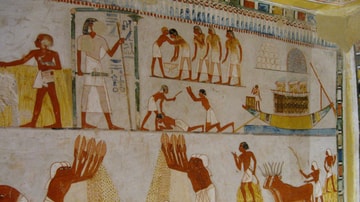
Social Structure in Ancient Egypt
The society of ancient Egypt was strictly divided into a hierarchy with the king at the top and then his vizier, the members of his court, priests and scribes, regional governors (eventually called 'nomarchs'), the...

Definition
Ahriman
Ahriman is the evil spirit in Early Iranian Religion, Zoroastrianism, and Zorvanism, Lord of Darkness and Chaos, and the source of human confusion, disappointment, and strife. He is also known as Angra Mainyu (evil spirit or dark spirit...

Definition
Columbian Exchange
The Columbian exchange is a term coined by Alfred Crosby Jr. in 1972 that is traditionally defined as the transfer of plants, animals, and diseases between the Old World of Europe and Africa and the New World of the Americas...
