
Search
Remove Ads
Advertisement
Search Results

Article
The Ancient Concept of a Noble Death
The act of voluntary death was never condemned in antiquity. In fact, The English word "suicide" comes from the Latin for "self-slaying." The reason for a voluntary death had to be one that was honorable and necessary...

Article
Clergy, Priests & Priestesses in Ancient Egypt
The ancient Egyptians understood that their gods had prevailed over the forces of chaos through the creation of the world and relied upon humanity's help to maintain it. The people of Mesopotamia held this...
Article
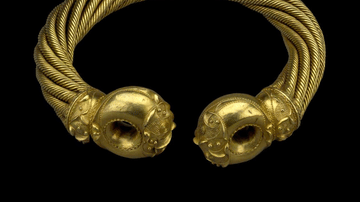
Ancient Celtic Torcs
In ancient Celtic cultures, torcs were a common form of jewellery and were made from bronze, copper, silver, and gold. Torcs were not just exquisite works of Celtic art but also identified the wearer’s status and perhaps were...

Definition
Renaissance Humanism
Renaissance Humanism was an intellectual movement typified by a revived interest in the classical world and studies which focussed not on religion but on what it is to be human. Its origins went back to 14th-century Italy...

Article
What happened to the Great Library at Alexandria?
Once the largest library in the ancient world, and containing works by the greatest thinkers and writers of antiquity, including Homer, Plato, Socrates and many more, the Library of Alexandria, northern...

Article
12 Great Cities of Ancient Mesopotamia - The Rise and Fall of the Earliest Cities in the World
The great cities of Mesopotamia ("the land between two rivers") developed prior to the late 4th millennium BCE along two rivers – the Tigris and Euphrates – and were...

Definition
Assyria
Assyria was the region located in the ancient Near East which, under the Neo-Assyrian Empire, reached from Mesopotamia (modern-day Iraq) through Asia Minor (modern Turkey) and down through Egypt. The empire began modestly at the city...
Definition
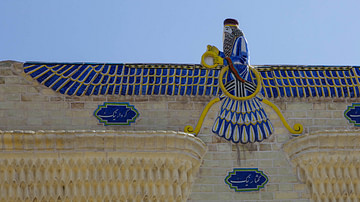
Zarathustra
Zarathustra (also given as Zoroaster, Zartosht, Zarathustra Spitama, l. c. 1500-1000 BCE) was the Persian priest-turned-prophet who founded the religion of Zoroastrianism (also given as Mazdayasna “devotion to Mazda”), the first monotheistic...

Definition
Neo-Assyrian Empire
The Neo-Assyrian Empire (912-612 BCE) was the final stage of the Assyrian Empire, stretching throughout Mesopotamia, the Levant, Egypt, Anatolia, and into parts of Persia and Arabia. Beginning with the reign of Adad Nirari...

Definition
Giza
Giza is a plateau southwest of modern Cairo which served as the necropolis for the royalty of the Old Kingdom of Egypt. Most famous for the pyramids of Khufu (completed c. 2560 BCE) Khafre (c. 2530 BCE) and Menkaure (c. 2510 BCE) and the...
