
Search
Remove Ads
Advertisement
Search Results

Article
Sicilian Temples (Greek Metrology)
Characteristics of Sicilian Archaic Temples The large dimensions of the components, the presence of a propteron, an adyton, and other specific elements of the plan and elevation speak for an originally very autonomous development of Sicilian...
Article
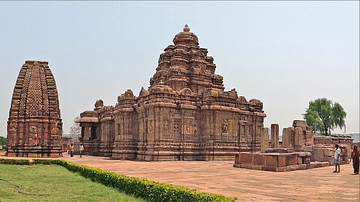
The Temples of Pattadakal
The history of Pattadakal goes back to a time when it was called Kisuvolal, a valley of red soil. It even found a mention in Ptolemy's Geography in the 2nd century CE. Presently Pattadakal is located in the district of Bagalkot, state of...

Image
Apollo, Olympia
Marble statue (severe style) of Apollo (c. 460 BCE) from the west pediment of the temple of Zeus, Olympia (Olympia Archaeological Museum).
Image
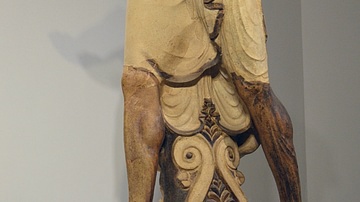
Apollo of Veii
Large scale terracotta sculpture depicting the Apollo of Veii (the Etruscan Aplu). From the roof of the Portonaccio Temple at Veii (Italy), around 510 BCE. (National Etruscan Museum of Villa Giulia, Rome)
Image
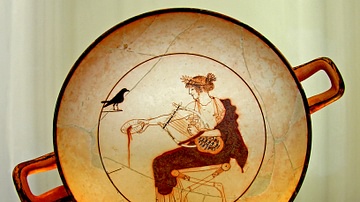
Apollo with Lyre
A kylix depicting the god Apollo pouring a libation and holding an early version of the lyre (chelys) which was made from the shell of a tortoise. The bird may represent the crow which announced the marriage of the nymph Aigle-Korone, the...
Image
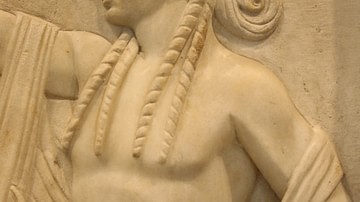
Apollo Marble Relief
Apollo, detail from a 2nd century CE funerary relief slab. (Archaeological Museum of Piraeus)

Image
Apollo, Macedonian Gold Stater
Macedonian gold stater, 359-336 BCE.
Obverse: Apollo
Reverse: Charioteer
Alpha Bank Numismatics Collection, Kerkyra, Corfu.

Image
Belvedere Apollo
The Belvedere Apollo statue considered to be a 2nd century CE copy of a bronze statue of the 4th century BCE by Leochares. The god would have once held a bow in his left hand. (The Vatican Museums, Rome).
Image
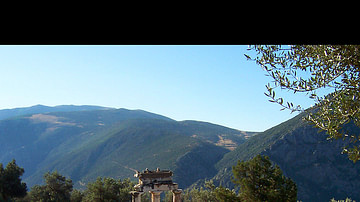
Sanctuary of Apollo in Delphi
Delphi was the site of the Delphic oracle, the most important oracle in the classical Greek world, when it was a major site for the worship of the god Apollo after he slew the Python, a deity who lived there and protected the navel of the...
Image
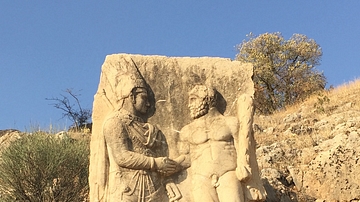
Apollo-Mithras Meets Antiochus I
Found in the ancient ruins of Arsameia, outside Kahta, Turkey, 15 km from the world heritage site of Nemrut Dagi, this stele portrays the meeting of Antiochus I (r. 70 BCE - c. 38 BCE) and Apollo. Antiochus - the ruler of the Commagene kingdom...
