
Search
Remove Ads
Advertisement
Search Results
Image
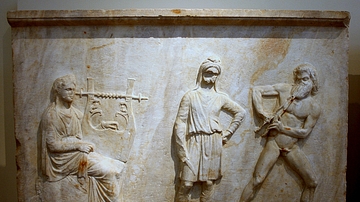
Apollo and Marsyas
National Archaeological Museum, Athens, 215. 330-20 BCE. This relief slab is one of four that made up the revetment of a pedestal (only three survive), and was found at Mantineia, Arcadia. The pedestal either acted as a base for a statue...

Image
Statue of Apollo Playing the Cithara from Miletus
Apollo is rendered as a muscular young man. However, the feminine sensuality displayed here is probably caused by his over-emphasized hips. His robe falls below the waist, exposing the external genitals. The fingers (now lost) of the left...

Definition
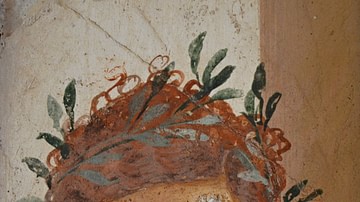
Midas - The Mythical King with the Golden Touch
Midas was a mythical king of Phrygia in Asia Minor who was famous for his extraordinary ability to change anything he touched into gold. This gift was given to him by Dionysos in thanks for his hospitality to the wise satyr Silenus. Midas...
Definition
Herculaneum
Herculaneum, located on the Bay of Naples, was a Roman town which was destroyed by the eruption of Mount Vesuvius in 79 CE. Like its neighbour Pompeii, the town was perfectly preserved by a metres-thick layer of volcanic ash which, in the...

Definition
Delos
Delos is a Greek island in the Cyclades archipelago which was both an influential political force and, with its sanctuary to the god Apollo, an important religious centre in the Archaic and Classical periods. The island was also a major commercial...
Image
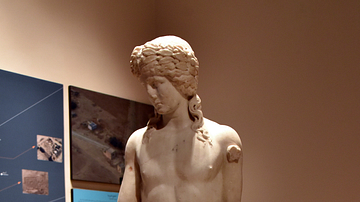
Marble Statue of Apollo from Samaria
Apollo was the god of music, light, truth, and healing in Graeco-Roman mythology, but this statue was found in a temple dedicated to "Kore", the goddess of the underworld and vegetation. The back of the statue was not polished, suggesting...
Definition
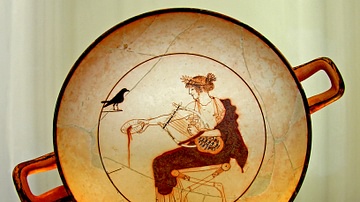
Lyre
The lyre was a stringed musical instrument played by the ancient Greeks. It was probably the most important and well-known instrument in the Greek world. The lyre was closely related to the other stringed instruments: the chelys which was...

Article
Greek Temples of Sicily
There are at least a thousand reasons to visit Sicily, the great island – indeed the largest in the Mediterranean – that forms the triangular football to the boot that is the Italian peninsula. They are all very good reasons, including amazing...

Image
Aerial View of Pompeii
A black and white photo taken c. 1900 CE of the Roman town of Pompeii, buried in volcanic ash following the eruption of Veusvius in 79 CE. In the foreground are two theatres.
Image
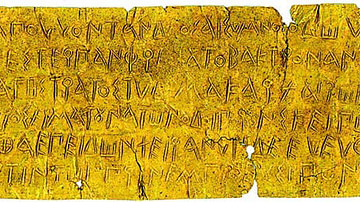
Greek Amulet Invoking Apollo
A beaten gold amulet stamped with a Greek text invoking the god Apollo. The text reads: INVOCATION TO THE GOD PHOEBUS APOLLO WHO RULES OVER MAN, POURING OUT LIBATIONS TO HIM, THAT HE MAY TAKE UP ARMS AND GO THROUGH THE ENEMY'S ARMY TO...
