
Search
Remove Ads
Advertisement
Search Results

Article
J. R. Giddings' Account of the Dade Massacre of the Second Seminole War
The Dade Massacre (also given as the Dade Battle, 28 December 1835) was the opening engagement of the Second Seminole War (1835-1842) between Euro-American forces and those of the Seminole...

Article
Battle of Cowpens
The Battle of Cowpens (17 January 1781) was a decisive battle in the southern theater of the American Revolutionary War (1775-1783). It saw a detachment of Continental soldiers and Patriot militia under Brigadier General Daniel...

Article
The Nûñnĕ′hĭ and Other Spirit Folk
The Nûñnĕ′hĭ are the Cherokee "spirit people", similar to the fairy as sometimes depicted in European medieval folklore, and The Nûñnĕ′hĭ and Other Spirit Folk is a collection of anecdotes about them compiled by...

Article
Trail of Tears: Memorial and Protest of the Cherokee Nation by John Ross
The Trail of Tears was the forced relocation of the "Five Civilized Tribes" – Cherokee, Chickasaw, Choctaw, Muscogee Creek, and Seminole – from their ancestral lands in the Southeastern...

Article
The Liberation of Jane Johnson - Her Famous Escape and Court Testimony
Jane Johnson (circa 1814/1827-1872) and her two young sons, Daniel and Isaiah, were slaves of one John Hill Wheeler of North Carolina, who brought them north to Philadelphia, Pennsylvania...

Article
Battle of Guilford Court House
The Battle of Guilford Court House (15 March 1781) was one of the last major engagements of the American Revolutionary War (1775-1783). Fought near Greensboro, North Carolina, it was a pyrrhic victory for the British...

Article
The Poems of Christopher Marlowe
Christopher Marlowe (1564-1593), also known as Kit Marlowe, was one of the most influential dramatists of Elizabethan theatre. Though he is best known for his plays, his poems were very popular in their time and are...

Book Review
Edge of Empires: A History of Georgia
Few English-language histories of the country and land of Georgia have been written. Donald Rayfield's Edge of Empires: A History of Georgia attempts to fill this gap. Rayfield is a scholar of Russian and Georgian...
Image
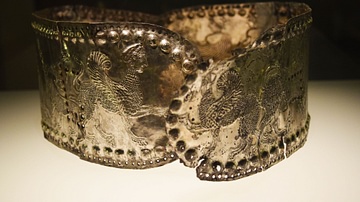
Ancient Belt from Colchis
Belt of an ancient noble from Colchis, found in Vani, Imereti region of western Georgia, in burial no. 24 dating from the end of the 4th century BCE.
Georgian National Museum, Tbilisi.
Image
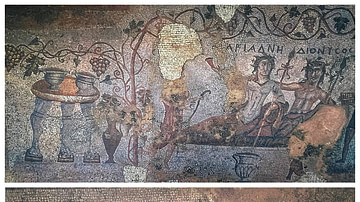
Roman Mosaics from Dzalisi
Two Roman mosaic panels from the thermal baths of a luxurious Roman-style villa at the Dzalisa Archaeological Site in Georgia near Mtskheta, dated to the 3rd century CE. The upper mosaic is devoted to the cult of Dionysus...
