
Search
Remove Ads
Advertisement
Search Results
![Head of a Sumerian Male from Tell Asmar [Right Side]](https://www.worldhistory.org/img/c/p/360x202/9687.jpg?v=1599123604)
Image
Head of a Sumerian Male from Tell Asmar [Right Side]
Limestone head of a statue of a Sumerian male; the rest of the body is lost. The eye sockets are empty but might well have been filled in with a white shell or a precious stone set in bitumen. Side...
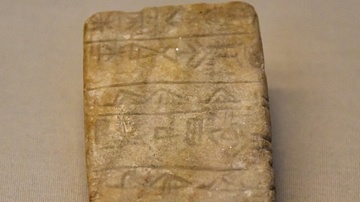
Image
Sumerian Stone Foundation Inscription
It was a Sumerian tradition to deposit or bury objects bearing inscriptions within temples and important public buildings. These recorded the names of the persons who were responsible for the building and also...
![Head of a Sumerian Male from Tell Asmar [Rear View]](https://www.worldhistory.org/img/c/p/360x202/9689.jpg?v=1599124502)
Image
Head of a Sumerian Male from Tell Asmar [Rear View]
Limestone head of a statue of a Sumerian male; the rest of the body is lost. The eye sockets are empty but might well have been filled in with a white shell or a precious stone set in bitumen. Me holding...
![Head of a Sumerian Male from Tell Asmar [Left Side]](https://www.worldhistory.org/img/c/p/360x202/9688.jpg?v=1599124502)
Image
Head of a Sumerian Male from Tell Asmar [Left Side]
Limestone head of a statue of a Sumerian male; the rest of the body is lost. The eye sockets are empty but might well have been filled in with a white shell or a precious stone set in bitumen. Side...

Video
Cuneiform Hand-Me-Downs - how Sumerian outlived its speakers
My favorite example of how odd Cuneiform became as it was passed from civilization to civilization. Thanks, rampant Sumerianization! Cuneiform languages took Sumerian very seriously, even...

Video
Enki - The Sumerian God Who Created Humanity
#history #historyfacts #historyfactsdaily #mythology #ancienthistory #sumerianmythology Enki – The Sumerian God Who Created Humanity Enki, the Sumerian god, is revered for his roles in water, knowledge...

Definition
Amorite
The Amorites were a Semitic people who seem to have emerged from western Mesopotamia (modern-day Syria) at some point prior to the 3rd millennium BCE. In Sumerian they were known as the Martu or the Tidnum (in the Ur III Period), in...

Article
Ten Ancient Elam Facts You Need to Know
Elam, located in the region of the modern-day provinces of Ilam and Khuzestan in Iran, was one of the most impressive civilizations of the ancient world. It was never a cohesive ethnic kingdom or polity but...

Image
Sumerian Votive Plaque
A votive plaque of white marble. The lower part shows two men carrying a large jar (probably filled with beer) and another man in front of them seems to steer an animal from behind, perhaps a cow or horse. At the upper part...

Image
Statue of a Sumerian Woman
The woman wears a garment which was probably made of a sheep skin. The garment was wrapped over the left shoulder only. There are long strands of wool hanging below the lower thighs. The women's eyes might well have been...
