
Search
Remove Ads
Advertisement
Search Results
Image
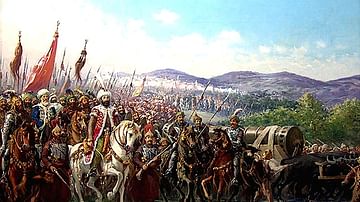
Mehmed II Conquering Constantinople
Mehmed II conquering Constantinople, oil on canvas painting by Fausto Zonaro, 1903.
Dolmabahçe Palace, Istanbul.

Image
Rus Attack on Constantinople
Rus army at the walls of Constantinople, miniature from Radziwiłł Chronicle (aka Königsberg Chronicle) fol 14v, early 13th century.
Saint Petersburg Academy of Sciences.

Article
Montpellier during the French Reformation
At the dawn of the French Wars of Religion (1562-1598), Montpellier in southern France had a significant Protestant minority that controlled the city's institutions. The Edict of Nantes in 1598 ended the wars...

Definition
Leo III
Leo III was emperor of the Byzantine Empire from 717 to 741 CE. He founded the Isaurian dynasty which ruled until 802 CE. The emperor was a talented administrator, and he revamped the empire's political apparatus and legal code. Leo's...

Article
Pilgrimage in the Byzantine Empire
Pilgrimage in the Byzantine Empire involved the Christian faithful travelling often huge distances to visit such holy sites as Jerusalem or to see in person relics of holy figures and miraculous icons on show from...

Article
10 Myths of the Alamo - How Did Davy Die?
The 13-day siege and Battle of the Alamo, 23 February to 6 March 1836, is among the most famous in American history, but, like any such event, it has inspired several myths, many accepted as historical fact...

Definition
Cniva - The Goth King Who Defeated Rome
Cniva (also given as Kniva, reign circa 250 to possibly 270) was the king of the Goths who defeated Emperor Decius (reign 249-251) at the Battle of Abritus in 251. Little is known of him other than his campaign...

Definition
Napoleon's Italian Campaign
The Italian campaign of 1796-1797, waged by a young Napoleon Bonaparte, was a decisive campaign in the French Revolutionary Wars (1792-1802). It led to the defeat of Austria, the beginning of French control of northern...

Definition
Trinity
The Christian doctrine of the Trinity (from the Latin trinus, meaning "threefold") professes that there is one God, but three eternal and consubstantial persons (aspects): the Father, the Son, and the Holy Spirit. The Father is the God...

Definition
Saint Cyril
Saint Cyril (aka Kyrillos and Constantine the Philosopher, d. 867 CE) was a Byzantine linguist, teacher, scholar and missionary who famously preached Christianity to the Slavs in Moravia with his brother Methodius during the 9th century...
