
Search
Did you mean: Oshun?
Remove Ads
Advertisement
Search Results
Definition
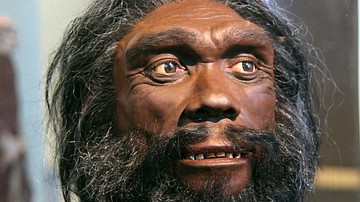
Homo Heidelbergensis
Homo heidelbergensis is an extinct species of human that is identified in both Africa and western Eurasia from roughly 700,000 years ago onwards until around 200,000 years ago – fitting snugly within the Middle Pleistocene...

Definition
Isthmia
Isthmia is a genitive noun with the meaning 'of the Isthmus.' It generally refers to the site that held the famous Isthmian Games near Corinth on the Isthmus. A natural assembly place for many Greeks and travellers. Isthmia in Antiquity...

Definition
Shinto Architecture
The architecture of the 80,000 Shinto shrines in Japan varies depending on geographical location, the deity worshipped, and the date of foundation. The earlier Shinto shrines tend to be simpler and less decorative affairs than...

Definition
Uluburun Shipwreck
The Uluburun shipwreck is a Bronze Age vessel discovered lying off the coast of Kas, Turkey. The ship, probably originally from Phoenicia/Canaan, dates to between 1330 and 1300 BCE and was carrying a full cargo of trade goods...
Definition
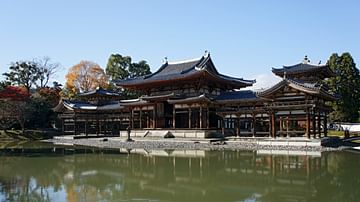
Heian Period
The Heian Period of Japanese history covers 794 to 1185 CE and saw a great flourishing in Japanese culture from literature to paintings. Government and its administration came to be dominated by the Fujiwara clan who eventually were...

Definition
Queen Himiko
Queen Himiko, also known as Pimiko or Pimiku (183? - 248 CE), was a 3rd-century CE ruler of the territory in ancient Japan known as Hsieh-ma-t'ai or Yamatai, later to be known as Yamato. Considered by the Chinese as the ruler of...

Definition
Mount Koya
Mount Koya (aka Koyasan), located in the Wakayama Prefecture, south of Osaka, Japan, is the site of a temple complex founded in 819 CE by the scholar monk Kukai as the headquarters for Shingon Buddhism. There are temples and sacred...

Definition
Jomon Pottery
The Jomon Period (c. 14,500 - c. 300 BCE) of ancient Japan produced a distinctive pottery which distinguishes it from the earlier Paleolithic Age. Jomon pottery vessels are the oldest in the world and their impressed decoration...

Definition
Inari
Inari is the Shinto god of rice, the protector of food, and bringer of prosperity. He has over 40,000 shrines dedicated to him large and small across Japan, the oldest and most important of which is the Fushimi Inari Shrine near Kyoto...

Definition
Colossi of Memnon
The Colossi of Memnon (also known as el-Colossat or el-Salamat) are two monumental statues representing Amenhotep III (1386-1353 BCE) of the 18th Dynasty of Egypt. They are located west of the modern city of Luxor and face east...
