
Search
Remove Ads
Advertisement
Search Results

Image
Tomb Niche & Stela of Chnumit
Limestone tomb niche with a false-door stela and 2 side walls. From the tomb of princess Chnumit (also written Khnumet), Saqqara (Sakkara), modern-day Egypt. Old Kingdom, 6th Dynasty, circa 2200 BCE. (State Museum of...
Image
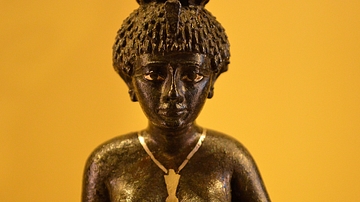
Lady Kheredouankh
Kheredouankh is the mother of the deified architect Imhotep, designer of the pyramid of Djoser at Saqqara. This statue is made from bronze covered with gold, between 664-332 BCE, probably from the region of Memphis. Louvre Museum...

Image
Death Mask of Khaemweset
Gold death mask, possibly of Khaemweset (c. 1281 - c. 1225 BCE), son of Ramesses II, Crown Prince, high priest of Ptah at Memphis and famous restorer of Egyptian monuments. Saqqara tomb, Egypt. (Louvre Museum, Paris)
Image
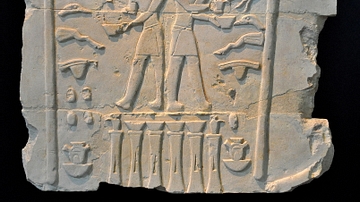
Offering Scene from the Tomb of Akhethetep
This limestone fragment depicts an offering scene. It was found inside the tomb of the high dignitary of Egypt Akhhethetep. From the mastaba (eternal house) of Akhhethetep, Saqqara (Sakkara), Egypt. Old Kingdom...
Image
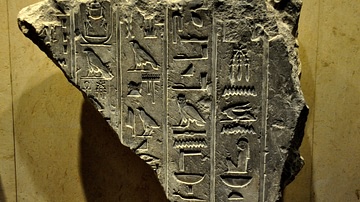
Pharaoh Senusret I
Limestone fragment of an inscription which mentions the name of the Egyptian pharaoh Senusret I (aka Sesostris I). From Saqqara (Sakkara), modern-day Egypt. Middle Kingdom, 12th Dynasty, circa 1950 BCE. (State Museum of Egyptian...
Image
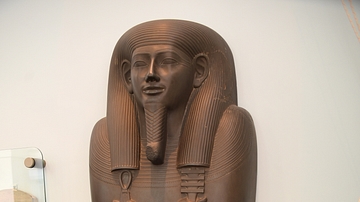
Sarcophagus Lid of Sisobek
Sisobek (Sasobek) assumes the guise and resurective powers of Osiris. He holds the djed (right) and tit (left), symbols of performance and life linked to Osiris and Isis. The winged sky goddess Nut enables his rebirth...
Image
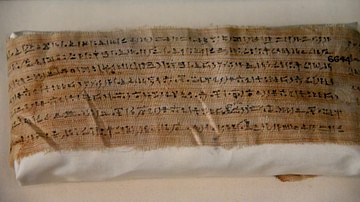
Mummy Linen Inscribed with Portion of the Book of the Dead
Mummy wrapping of a man named Djedher, son of Sekhmetnefret, inscribed in hieratic with funerary texts from the Egyptian Book of the Dead. From Saqqara, Egypt, Late Period of ancient Egypt, 4th...

3D Image
Pyramidion of Ptahemwia
Limestone, Saqqara (Egypt), 18th Dynasty (c. 1325-1300 BC) From the 18th Dynasty onwards, mudbrick pyramids were used to mark the tombs of private individuals. These small structures were topped by a stone pyramidion...

Video
The Seated Scribe, c. 2620-2500 B.C.E.
More free lessons at: http://www.khanacademy.org/video?v=cxs1d3N60UI The Seated Scribe, c. 2620-2500 B.C.E., c. 4th Dynasty, Old Kingdom, painted limestone with rock crystal, magnesite, and copper/arsenic inlay...

Video
Ancient Medicine, Healing and Physicians in Antiquity
Medicine in the ancient world was often combined with what we would consider magic, especially in Ancient Mesopotamia and Egypt. In Mesopotamia, the goddess Gula who is also known as Ninkarrak and...
