
Search
Remove Ads
Advertisement
Search Results

Definition
Tomb - Home of the Dead
A tomb is an enclosed space for the repository of the remains of the dead. Traditionally tombs have been located in caves, underground, or in structures designed specifically for the purpose of containing the remains of deceased...

Definition
Cambyses II
Cambyses II (r. 530-522 BCE) was the second king of the Achaemenid Empire. The Greek historian Herodotus portrays Cambyses as a mad king who committed many acts of sacrilege during his stay in Egypt, including the slaying of the sacred...

Image
Fragment from pyramid of king Pepi I
This limestone block fragment came from the debris of the north wall of the antechamber within the pyramid of king Pepi (Pepy) I at Saqqara. The fragment contains 5 vertical columns of green-filled hieroglyphic...

Definition
Egyptian Faience
Egyptian faience is a glassy substance manufactured expertly by the ancient Egyptians. The process was first developed in Mesopotamia, first at Ur and later at Babylon, with significant results but faience production reached its...

Article
Food & Drink in Ancient Egypt
Food and drink in ancient Egypt relied on barley and wheat, the primary crops cultivated along the Nile. The Egyptian diet was based on bread, beer, and vegetables. Meat was expensive and only rarely eaten. The majority...

Article
A Brief History of Egyptian Art
Art is an essential aspect of any civilization. Once the basic human needs have been taken care of such as food, shelter, some form of community law, and a religious belief, cultures begin producing artwork, and often...

Article
Dogs in the Ancient World
Dogs have been a part of the history of human beings since before the written word. The ancient temple of Gobekli-Tepe in Turkey, dated to at least 12,000 years BCE, has provided archaeologists with evidence of domesticated...

Article
Clergy, Priests & Priestesses in Ancient Egypt
The ancient Egyptians understood that their gods had prevailed over the forces of chaos through the creation of the world and relied upon humanity's help to maintain it. The people of Mesopotamia held this...
Article
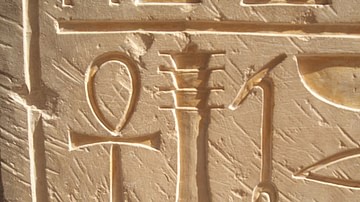
Ancient Egyptian Symbols
Religion in ancient Egypt was fully integrated into the people's daily lives. The gods were present at one's birth, throughout one's life, in the transition from earthly life to the eternal, and continued their care for...

Article
Music & Dance in Ancient Egypt
Music and dance were highly valued in ancient Egyptian culture, but they were more important than is generally thought: they were integral to creation and communion with the gods and, further, were the human response...
