
Search
Remove Ads
Advertisement
Search Results
Image
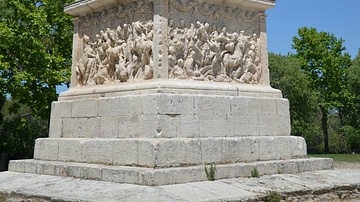
Mausoleum of the Julii
The Mausoleum of the Julii at Glanum, southern France, is one of the best preserved mausoleums of the Roman era. Based on its artistic style, the Mausoleum was probably built between 40 and 20 BCE. An inscription mentions...

Definition
The Seven Wonders
The Seven Wonders of the Ancient World were seven impressive structures famously listed by ancient writers including Philo of Byzantium, Antipater of Sidon, Diodorus Siculus, Herodotus, Strabo, and Callimachus of Cyrene, among...
Image
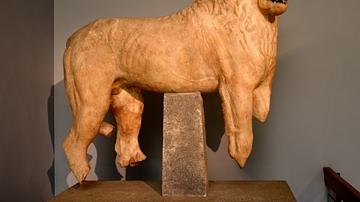
Marble Lion, Mausoleum at Halicarnassus
This is the most complete of the surviving lions from the Mausoleum at Halicarnassus, also known as the Tomb of Mausolus. The lions probably stood at the base of the stepped-pyramid roof, acting as both protective...

Image Gallery
5 British Royal Houses
In this gallery, we look at the history of the last five royal houses of Britain through their family trees. From the Wars of the Roses to the current House of Windsor, we see an evolution from absolute rule to a constitutional...
Image
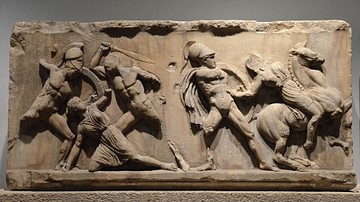
Amazonomachy Relief from the Mausoleum at Halicarnassus
Slab from the Amazonomachy frieze depicting five figures, three Greeks and two Amazons, and a horse. From the Mausoleum at Halicarnassus, around 350 BCE (British Museum).
Image
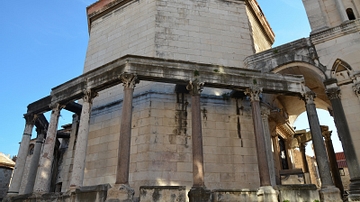
Diocletian's Mausoleum
The octagonal mausoleum of Diocletian (now Cathedral of St. Domnius) inside Diocletian's Palace, Split (Croatia). Diocletian's Palace was built between 293-303 CE in preparation for his retirement on 1 May 305 CE.
Image
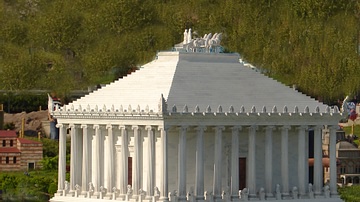
Model of the Mausoleum at Halicarnassus
A modern scale model of what the 4th century BCE Mausoleum at Halicarnassus may have looked like, one of the Seven Wonders of the world. (Miniatuk, Istanbul)

Image
The Centaur Frieze of the Mausoleum at Halicarnassus
This is a marble slab of the so-called Centaur frieze of the Mausoleum at Halicarnassus, also known as the Tomb of Mausolus. The whole frieze depicts a violent conflict between Greeks and Centaurs...
Image
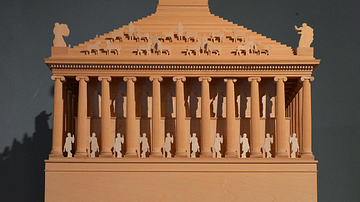
Model of the Mausoleum of Halicarnassus
Model of the Mausoleum of Halicarnassus.
Image
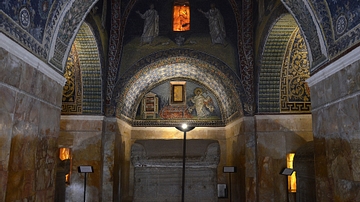
Mausoleum of Galla Placidia, Ravenna
General view of the interior of the mausoleum of Galla Placidia in Ravenna with her sarcophagus in the middle. Galla Placidia (388-450 CE) was the daughter of the Roman Emperor Theodosius I.
