
Search
Remove Ads
Advertisement
Search Results

Article
The Foundation of the Royal Society
The Royal Society was founded in 1662 to promote scientific research and increase our knowledge of the natural world. With royal patronage and a stellar membership of great minds, the society quickly gained international...

Article
The Masaesyli and Massylii of Numidia
The North African Berber kingdom of Numidia (202-40 BCE) was originally inhabited by a tribe (or federation of tribes) known as the Masaesyli, to the west, and a coalition of smaller tribes, known as the Massylii...

Image
Bust of Ptolemy of Mauretania, Louvre
A marble bust of King Ptolemy of Mauretania (c. 10 BCE - c. 40 CE). Ptolemy was the son of Juba II and Cleopatra Selene II, making him a descendant of both the Berber rulers of Numidia and the Ptolemaic dynasty...

Article
Royal Women in the Mughal Empire
It was not only the Mughal emperors that left an indelible mark in the history of the Indian subcontinent but also the queens and princesses. The latter's contributions to art, architecture, literature, cuisine, refinement...
Image
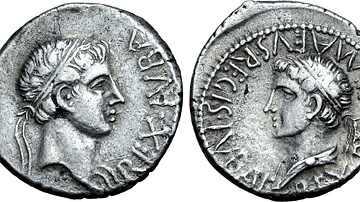
Juba II & Ptolemy of Mauretania
Coin from the co-regency of Juba II (r. 29 BCE - 23 CE) and Ptolemy of Mauretania (c. 10 BCE - c. 40 CE). Left; Juba II, Right; Ptolemy of Mauretania. Silver Denarius, minted c. 20-24 CE. Minted in Caesarea, Mauretania...

Definition
Halicarnassus
Halicarnassus (modern Bodrum, Turkey) was an ancient Ionian Greek city in the region of Caria, located on the coast of Anatolia. It is best known as the birthplace of Herodotus (l. c. 484-425/413 BCE), the 'Father of History', and...
Image
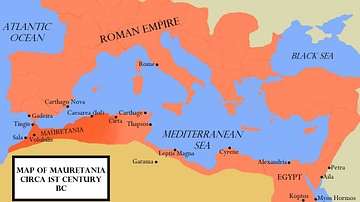
Map of the Kingdom of Mauretania
A map of the Kingdom of Mauretania, circa late 1st Century BCE.

Article
Exploring Roman Morocco
Morocco, then known as Mauretania, was annexed by the Roman Empire in 40 CE. The Romans in Morocco left a vast legacy with archaeological sites that dot the country's northern landscape, especially Volubilis, with its vestiges...

Image
Triumph of Dionysus Mosaic from Caesarea in Mauretania
The mosaic of the Triumph of Dionysus was found in a private house of Caesarea in Mauretania. The central panel depicts Dionysus holding a thyrsus and riding a chariot drawn by two tigers. It is...

Article
The Royal Macedonian Tombs at Vergina
Excavations at Vergina in northern Greece in the late 1970s CE unearthed a cluster of tombs thought to be the burial site of Philip II (r. 359-336 BCE), the father of Alexander the Great (r. 336-323 BCE), with...
