
Search
Did you mean: Roman Art?
Remove Ads
Advertisement
Search Results

Video
The Cult of the Emperor in the Roman Empire
Did you know that Rome’s Imperial Cult never claimed the living emperor was a god? This video is all about the Imperial Cult or the cult of the emperor of ancient Rome, what it meant, and how it worked...

Video
The Jolly Roman Festival of Saturnalia
Did you know that the festive greeting Io Saturnalia to the Romans was much like Merry Christmas, or Happy Holidays is to us today? This video is all about the earliest predecessor to Christmas, the Roman festival...

Definition
Caracalla
Caracalla was Roman emperor from 211 to 217 CE. Born Lucius Septimius Bassianus, son of Septimius Severus and Julia Domna, he became co-ruler with his father in 198 CE and sole ruler after the death of his father in 211 CE and of his...

Definition
Shapur I
Shapur I (r. 240-270 CE) is considered one of the greatest kings of the Sassanian Empire for expanding his realm, his policy of religious tolerance, building projects, and committing the Zoroastrian scriptures (Avesta) to writing. He...

Definition
Galla Placidia
Galla Placidia (388-450 CE), the future empress, was the half-sister of the Westen Roman emperor Flavius Honorius (r. 395-423 CE), and the daughter of Theodosius the Great (r. 379-395 CE). She was taken hostage by Alaric during...

Definition
Neptune
Neptune is the Roman god of the sea and the Roman equivalent of the Greek god Poseidon. He was originally a god of fresh water and became associated with Poseidon early on in Roman history. He lives in a golden palace at the bottom of...

Definition
Caesarea Maritima
Caesarea Maritima was a city built over 2,000 years ago (c. 22-10 BCE) on the coast of the Eastern Mediterranean. With Roman engineering and largesse, Herod the Great (r. 37-4 BCE) accomplished this feat by constructing a whole...

Definition
Ambiorix
Ambiorix (c. 54/53 BCE) was the co-ruler of the Eburone tribe of Gallia Belgica (north-eastern Gaul, modern-day Belgium) who led an insurrection against Caesar's occupying forces in Gaul in the winter of 54/53 BCE. Nothing is known...

Article
Rome under the Julio-Claudian Dynasty
The Julio-Claudians were the first dynasty to rule the Roman Empire. After the death of the dictator-for-life Julius Caesar in 44 BCE, his adopted son Octavian - later to become known as Augustus (r. 27 BCE -...
Article
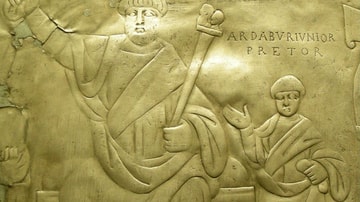
The Isaurians and the End of Germanic Influence in Byzantium
Germanic influence reigned in the Roman Empire from the end of the 4th century CE through the 5th. Germanic individuals took important posts in the government and the military, and Germanic...
