
Search
Remove Ads
Advertisement
Search Results
Image
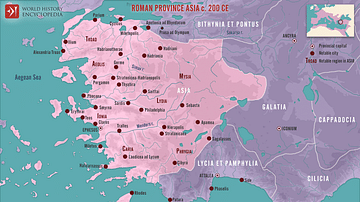
Roman Province Asia c. 200 CE
This map illustrates the Roman province of Asia around 200 CE. Established in 129 BCE following the bequest of the Attalid Kingdom of Pergamon to Rome, it encompassed western Anatolia (modern-day Turkey). It was a wealthy...

Image
Roman Province Bithynia et Pontus c. 200 CE
The Roman province of Bithynia et Pontus, established in 63 BCE after the defeat of Mithridates VI of Pontus, was a prosperous and strategically significant region by 200 CE. Located in northern Anatolia...
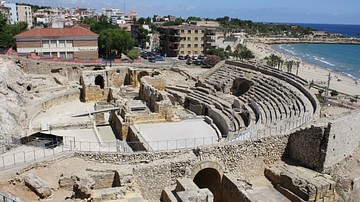
Image Gallery
A Gallery of 12 Roman Amphitheatres
In this gallery, we showcase 12 amphitheatres, a structure built throughout the Roman empire where ordinary people could watch such spectacles as gladiator games, mock naval battles, wild animal hunts, and public...

Image
Roman Street at Deultum
Roman Street at Deultum, photograph by Carole Raddato, Bulgaria, 16 August, 2024. A stone-paved Roman street beside the public baths of Deultum (modern Debelt), Bulgaria. The Roman colony was laid out on a regular street...

Image
Map of Roman & Parthian Trade Routes
This map shows the Roman-Parthian trade route system, circa between the 1st and the 3rd centuries CE. During this period, the Roman Empire and the Parthian Empire were the two superpowers of the region and the...

Definition
Renaissance Architecture
Renaissance architecture originated in Italy and superseded the Gothic style over a period generally defined as 1400 to 1600. Features of Renaissance buildings include the use of the classical orders and mathematically...

Definition
Thugga
Thugga (also Dougga) was a town in North Africa which was first a Numidian and then a Carthaginian settlement before being incorporated into the Roman Empire. The town was built on a strategically favourable limestone hilltop overlooking...

Image
Roman Lead Funerary Box
This lead container was used to store a glass funerary urn containing the ashes of the deceased. 1st-2nd century CE, Empuries (Emporiae), Spain. (Archaeological Museum, Empuries)
Definition
De Officiis
De Officiis is a treatise written by Marcus Tullius Cicero (106 – 43 BCE), Roman statesman and orator, in the form of a letter to his son just after the death of Julius Caesar in 44 BCE. Strongly influenced by stoicism, De Officiis...

Video
Eros-Cupid and Psyche, the Greek and Roman Gods of Love and the Soul
Eros in Greek mythology, known as Cupid in Rome, is the god of love but more specifically, the god of physical and passionate desire. He is often referred to as a son and attendant of...
