
Search
Remove Ads
Advertisement
Search Results

Article
The Gold Crowns of Silla
The Silla Kingdom ruled south-eastern Korea during the Three Kingdoms period (1st century BCE - 7th century CE) and then, as the Unified Silla Kingdom, all of Korea from 668 to 935 CE. The Silla produced fine pieces of...

Article
Trade in the Phoenician World
The Phoenicians, based on a narrow coastal strip of the Levant, put their excellent seafaring skills to good use and created a network of colonies and trade centres across the ancient Mediterranean. Their major trade...

Image
Map of Roman Rule in Asia Minor, c. 200 CE
This map illustrates the geopolitical landscape of Asia Minor during the reign of Emperor Septimius Severus (193–211 CE), around the year 200 CE. By this time, the peninsula (modern-day Turkey) had been under...

Video
Pompey the Great - Statesman and General of the Roman Republic
Gnaeus Pompeius Magnus, also known as Pompey or Pompey the Great, was a military leader and politician during the fall of the Roman Republic. He was born in 106 BCE and died on 28th September...

Image
Map of the Roman Rule in the Levant, c. 200 CE
The Roman Levant around 200 CE, during the height of imperial consolidation under the Severan dynasty (193 - 235 CE), formed one of the empire’s most dynamic and interconnected frontier regions. Administratively...

Video
Marcus Aurelius: The Philosopher & Emperor of the Roman Empire
Marcus Aurelius (r. 161 to 180 CE) was a Roman emperor best known as the last of the Five Good Emperors of Rome (following Nerva, Trajan, Hadrian, and Antoninus Pius) and as the author of the...

Definition
Cicero
Marcus Tullius Cicero was a Roman orator, statesman, and writer. He was born on 3 January 106 BCE at either Arpinum or Sora, 70 miles south-east of Rome, in the Volscian mountains. His father was an affluent eques, and the family was...

Article
The Batavian Revolt
Batavian revolt was a rebellion of the Batavians against the Romans in 69-70 CE. After initial successes by their commander Julius Civilis, the Batavians were ultimately defeated by the Roman general Quintus Petillius Cerialis...
Image
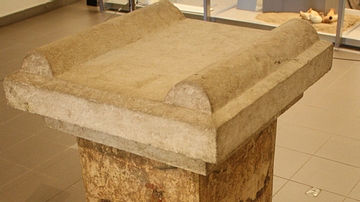
Roman Garden Altar, Empuries
A marble altar from the garden of a private Roman home in Empuries (Emporiae). 1st century CE, domus 2B. The sides are decorated with painted scenes of a cockerel and, on the reverse side, a two-handled glass vessel...

Image
Roman Funerary Urns
Roman glass funerary urns. 1st-2nd century CE, Tarraco. (Archaeological Museum, Tarragona, Spain)
