
Search
Remove Ads
Advertisement
Search Results

Image
The Baths of the Roman Empire - The Architecture of Daily Life
Public bathhouses (balnea and large imperial thermae) were a defining feature of urban life across the Roman Empire (27 BCE–476 CE in the West). Building on earlier bathing traditions in the...

Article
The Athenian Calendar
The term "Athenian Calendar" (also called the "Attic Calendar") has become somewhat of a misnomer, since Ancient Athenians never really used just one method to reckon the passage of time. Athenians, especially from the 3rd...

Definition
Dacia
Dacia was a region inhabited by the Dacians in the north of the Danube (modern Romania). The kingdom of Dacia was the creation of Burebistas (c. 80-44 BCE), who conquered and united several other Dacian principalities. Burebistas practically...

Definition
Commius
Commius was an Atrebates noble during Julius Caesar's Gallic Wars (58-50 BCE) who turned from Roman ally to indomitable foe. As king of the Atrebates, Commius ably served Caesar in Britannia and Gaul before becoming one of the main leaders...

Definition
Battle of Pydna
The Battle of Pydna in June 168 BCE was a decisive Roman victory that ended the Third Macedonian War and established Rome as the dominant power in the Mediterranean. The Roman Republic was expanding, enlarging its sphere of influence...

Article
Rome's Response to the Spread of Christianity
During the 1st century CE, a sect of Jews in Jerusalem claimed that their teacher, Jesus of Nazareth, was the 'messiah' of Israel. 'Messiah' meant 'anointed one', or someone chosen by the God of Israel...
Article
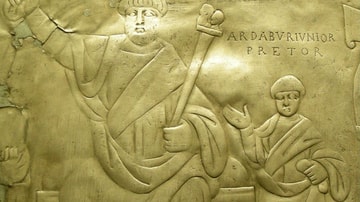
The Isaurians and the End of Germanic Influence in Byzantium
Germanic influence reigned in the Roman Empire from the end of the 4th century CE through the 5th. Germanic individuals took important posts in the government and the military, and Germanic...

Definition
Brennus
Brennus (c. 390 BCE) was the Gallic war chief of the Senones who sacked and occupied Rome in 390 BCE. Nothing is known of him outside of the accounts given of this event which immortalized him as coining the phrase, “Woe to the Vanquished”...

Video
The Ancient Roman Emperor Hadrian
Hadrian (l. 78-138 CE) was emperor of Rome (r. 117-138 CE) and is recognized as the third of the Five Good Emperors (Nerva, Trajan, Hadrian, Antoninus Pius, and Marcus Aurelius) who ruled justly. His reign marked...

Video
The Cult of the Emperor in the Roman Empire
Did you know that Rome’s Imperial Cult never claimed the living emperor was a god? This video is all about the Imperial Cult or the cult of the emperor of ancient Rome, what it meant, and how it worked...
