
Search
Did you mean: Critias?
Remove Ads
Advertisement
Search Results

Definition
Labyrinth
The word labyrinth comes from the Greek labyrinthos and describes any maze-like structure with a single path through it which differentiates it from an actual maze which may have multiple paths intricately linked. Etymologically the...

Definition
Hatshepsut
Hatshepsut (r. 1479-1458 BCE) was the first female ruler of ancient Egypt to reign as a male with the full authority of pharaoh. Her name means "Foremost of Noble Women" or "She is First Among Noble Women". She began her reign as...

Definition
Inanna - The Most Popular Goddess of Ancient Mesopotamia
Inanna is the ancient Sumerian goddess of love, sensuality, fertility, procreation, and also of war. She later became identified by the Akkadians and Assyrians as the goddess Ishtar, and further...
Definition
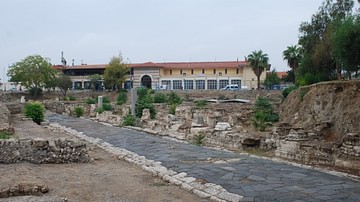
Tarsus
Tarsus was a city in ancient Cilicia located in the modern-day province of Mersin, Turkey. It is one of the oldest continually inhabited urban centers in the world, dating back to the Neolithic Period. It was built close by the Cydnus...

Definition
Ancient Greek Warfare
In the ancient Greek world, warfare was seen as a necessary evil of the human condition. Whether it be small frontier skirmishes between neighbouring city-states, lengthy city-sieges, civil wars, or large-scale battles between...

Definition
Lindow Man
The Lindow Man (officially Lindow III) is the top half of a male body, found preserved in a peat bog in Cheshire, England. The peat bogs at Lindow Moss date back to the last ice age and were formed by holes of melting ice; they are...

Definition
Kauravas
The Kauravas are the 100 sons of the King of Hastinapur, Dhritarashtra, and his wife Gandhari who played a significant role in the legendary Indian epic, the Mahabharata. Hastinapur is assumed to be the current modern state of Haryana...

Definition
Lumbini
Lumbini is a village, archaeological site, and place of pilgrimage honored as the birthplace of Siddhartha Gautama (the Buddha, l. c. 563-483 BCE) located in modern-day Rupandehi District of Nepal, Province 5, near the Indian border...

Definition
Nazca Civilization
The Nazca civilization flourished on the southern coast of Peru between 200 BCE and 600 CE. They settled in the Nazca and other surrounding valleys with their principal religious and urban sites being Cahuachi and Ventilla...

Definition
Huns
The Huns were a nomadic tribe prominent in the 4th and 5th century whose origin is unknown but, most likely, they came from "somewhere between the eastern edge of the Altai Mountains and the Caspian Sea, roughly modern Kazakhstan" (Kelly...
