
Search
Remove Ads
Advertisement
Search Results

Definition
Romulus and Remus
In Roman mythology, Romulus and his twin brother Remus were the founders of the city of Rome. They were the children of Rhea Silvia and Mars (or in some variations the demi-god hero Hercules) and their story is recorded by many...

Definition
Herman Melville
Herman Melville (1819-1891) was a 19th-century American author of novels, short stories and poetry. He is best known for his novel Moby Dick, published in 1851, and his short stories Bartleby the Scrivner and Billy Budd, Sailor...

Definition
Byzantine Art
Byzantine art (4th - 15th century CE) is generally characterised by a move away from the naturalism of the Classical tradition towards the more abstract and universal, there is a definite preference for two-dimensional representations...

Definition
Almourol Castle - Island Fortress of the Knights Templar
Almourol Castle in Portugal was built on a 310-meter-long and 75-meter-wide granite islet in the middle of the Tagus River. Earlier Roman and Moorish structures were completely remodelled in 1171...

Definition
Venus
In Roman mythology, Venus was the goddess of love, sex, beauty, and fertility. She was the Roman counterpart to the Greek goddess Aphrodite. However, Roman Venus had many abilities beyond the Greek Aphrodite; she was a goddess of victory...

Definition
Aphrodite
Aphrodite was the ancient Greek goddess of love, beauty, desire, and all aspects of sexuality. She could entice both gods and men into illicit affairs with her beauty and whispered sweet nothings. Aphrodite was born near Cyprus from...

Definition
Merlin
Merlin (also known as Myrddin, Merlinus) is the great wizard of the Arthurian Legends best known from Sir Thomas Malory's Le Morte D'Arthur (1469 CE). The character was created by Geoffrey of Monmouth in his History of the Kings of Britain...

Definition
Islamic Caliphates
Caliphate (“Khilafat” in Arabic) was a semi-religious political system of governance in Islam, in which the territories of the Islamic empire in the Middle East and North Africa and the people within were ruled by a supreme...

Definition
Jan Žižka
Jan Žižka (l. c. 1360 – 1424) was a Czech general and one of the most brilliant tacticians in military history. In the Hussite Wars (1419 to c. 1434), he was undefeated as the leader of the Hussites against the Catholic loyalists...
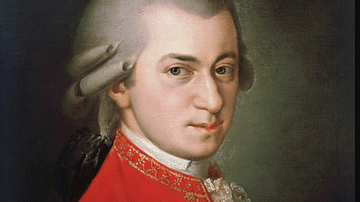
Definition
Wolfgang Amadeus Mozart
Wolfgang Amadeus Mozart (1756-1791) was an Austrian composer who wrote a wide range of works including piano concertos, string quartets, symphonies, operas, and sacred music. Regarded as one of or perhaps the greatest natural...
