
Search
Remove Ads
Advertisement
Search Results

Definition
Writing - The Preservation of Human Thought and Action
Writing is the physical manifestation of a spoken language. It is thought that human beings developed language circa 35,000 BCE as evidenced by cave paintings from the period of the Cro-Magnon Man...

Definition
Heiankyo
Heiankyo (Kyoto), located in the centre of Honshu island, was the capital of Japan for over a thousand years and gave its name to one of the golden ages of Japanese history, the Heian Period (794-1185 CE). Built according to Chinese...
Definition
Hyangga
Hyangga was a form poetical 'country song,' distinct from contemporary Chinese songs, which were written in the Silla and Goryeo kingdoms of ancient Korea between the 7th and 10th century CE. The indigenous songs cover such topics as...

Definition
Early Joseon Period
The Early Joseon Period (1392 - c. 1550 CE) in Korea was bookended by internal power struggles but witnessed major scientific and societal advances and prosperity. The Joseon (Choson) Dynasty ruled Korea from 1392 CE to 1897...
Definition
Kukai - Japan's Founder of Shingon Buddhism
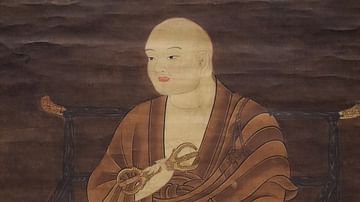
Kukai or Kobo Daishi (774-835 CE) was a scholar, poet, and monk who founded Shingon Buddhism in Japan. The monk became the country's most important Buddhist saint and has been credited with all manner of minor...

Definition
Karakorum - Capital of the Mongol Empire
Karakorum (aka Qaraqorum, modern name: Harhorin) is located in the Orkhon Valley of central Mongolia and was the capital of the Mongol Empire from 1235 to 1263. Ogedei Khan (r. 1229-1241) ordered its construction...

Article
Tea in Ancient China & Japan
Tea, still probably the world's most popular prepared beverage, was first drunk by Chinese monks to aid meditation and those who valued its medicinal qualities, but it quickly grew in popularity, spreading to other East...

Article
Ancestor Worship in Ancient China
Ancestor worship in ancient China dates back to the Neolithic period, and it would prove to be the most popular and enduring Chinese religious practice, lasting well into modern times. The family was always an important...

Video
Chinese Religions Throughout The Dynasties
This video describes the various religions of China throughout the dynasties, and associated beliefs.

Image
Chinese Dragon Roof Tile
A glazed ceramic roof tile depicting a dragon. Nanjing, Ming dynasty, 1366-1400.
The British Museum, London.
