
Search
Remove Ads
Advertisement
Search Results

Article
Liangzhu Culture Jade
Jade artifacts and icons are almost synonymous with the Chinese culture going back thousands of years. Jade (nephrite) was first worked into recognizable objects c. 6000 BCE during the period of the Houli Culture (c. 6500...

Article
The Mongol Invasions of Japan, 1274 and 1281
The Mongol invasions of Japan took place in 1274 and 1281 CE when Kublai Khan (r. 1260-1294 CE) sent two huge fleets from Korea and China. In both cases, the Japanese, and especially the samurai warriors...

Video
[The Greatest Chinese Literature] The Dream of the Red Chamber Book I, Part 1 (by Xueqin Cao)
The main text starts at 1:18 mark. This book is one of the Four Great Classical Novels of China, and considered the greatest of them all. This book is truly epic in...

Video
The Heavenly King of The Chinese: Shang Di
This video describes the heavenly king and lord of the Chinese, Shang Di, and his significance to Chinese culture.

Video
The Chinese Myth of the Immortal White Snake (Part 1)
Dive into the world of Chinese folk tales with the myth of the white snake, a story of the demon Bai Su Zhen and her love, Xu Xian. (Part One of the myth of the white snake). — The talented...

Video
The Chinese Myth of the Meddling Monk - Shunan Teng
Will Bai Su Zhen, the white snake demon, and her love, Xu Xian, ever be free of the meddling monk? (Part Two of the myth of the white snake). — Xu Xian had just received an invitation to the opening...

Article
The Mandate of Heaven and The Yellow Turban Rebellion
Throughout history, in order for a government to be respected and obeyed, it must possess some form of legitimacy recognized by the governed. Governmental systems have relied on a number of models...
Definition
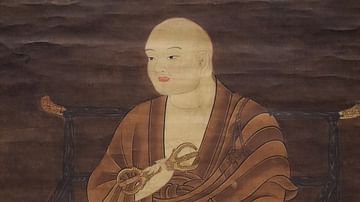
Kukai - Japan's Founder of Shingon Buddhism
Kukai or Kobo Daishi (774-835 CE) was a scholar, poet, and monk who founded Shingon Buddhism in Japan. The monk became the country's most important Buddhist saint and has been credited with all manner of minor...

Definition
Karakorum - Capital of the Mongol Empire
Karakorum (aka Qaraqorum, modern name: Harhorin) is located in the Orkhon Valley of central Mongolia and was the capital of the Mongol Empire from 1235 to 1263. Ogedei Khan (r. 1229-1241) ordered its construction...

Definition
Kofun Period
Following the Yayoi Period of Japan when farming and metalworking techniques were introduced from mainland Asia was the Kofun Period (c. 250 CE - 538 CE) where the religion of Shinto emerges from the beliefs of previous eras and...
