
Search
Remove Ads
Advertisement
Search Results

Article
Women in the Mongol Empire
Women in the Mongol Empire (1206-1368 CE) shared the daily chores and hardships of steppe life with men and were largely responsible for tending animals, setting up camps, childrearing, producing food and cooking it. Having...

Article
Social, Political & Economic Landscapes in Kautilya's Arthashastra
The Arthashastra (or Arthaśāstra) is one of the oldest surviving treatises on statecraft. There is considerable debate about the dating and authorship of the text; it underwent compilation...

Interview
Interview: American School of Classical Studies at Athens
The American School of Classical Studies in Greece has been running its operations since the 19th century CE, with excavations across the country and an academic program that runs throughout the...

Article
Top 5 Roman Sites in Southern Spain
Almost 700 years of continuous Roman occupation have left impressive traces in the Spanish landscape. Spain was then known as 'Hispania' and is now a fascinating location for the archaeological traveller. The...

Article
The Separation of Christianity from Judaism
In the mid-2nd century CE, Christianity began a gradual process of identity-formation that would lead to the creation of a separate, independent religion from Judaism. Initially, Christians were one of many...
Article
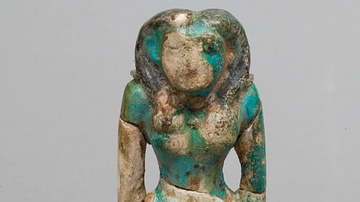
Tattoos in Ancient Egypt
Tattoos are an ancient form of art appearing in various cultures throughout history. One of the earliest (and possibly the oldest) pattern of tattoos in the world was discovered on the frozen remains of the man known as...

Article
Hei Tiki
The hei tiki is a small personal adornment, fashioned by hand from tough pounamu (New Zealand greenstone or nephrite jade), and is worn around the neck. Hei means something looped around the neck, and tiki is a generic word used throughout...

Article
The Ideology of the Holy Roman Empire
"The Holy Roman Empire was in no way holy, nor Roman, nor an empire," wrote Voltaire, and this interpretation still dominates the popular imagination, so the Holy Roman Empire is treated as a bad joke, a pale...

Article
Shulgi and Ninlil's Barge - A Poem Celebrating a Divine Event
Shulgi and Ninlil's Barge is a Sumerian poem dated to the reign of Shulgi of Ur (2094 - circa 2046 BCE) celebrating the caulking of the barge of the goddess Ninlil, consort of the sky god Enlil...

Article
The Importance of the Lydian Stater as the World's First Coin
The Lydian Stater was the official coin of the Lydian Empire, introduced before the kingdom fell to the Persian Empire. The earliest staters are believed to date to around the second half of...
