
Search
Did you mean: Plato?
Remove Ads
Advertisement
Search Results

Definition
Iranian Revolution
The Iranian Revolution (1978-1979) was the social movement that arose from widespread and diverse discontent with the monarchic government of Iran. The revolution was fought against the regime of Mohammad Reza Shah (r. 1941-1979...

Definition
Joseph E. Johnston - The Confederate General Who Defied Jefferson Davis
Joseph E. Johnston (1807-1891) was a Confederate general in the American Civil War (1861-1865). Known for his cautious style of command, he led the Army of Northern Virginia and the...
Definition
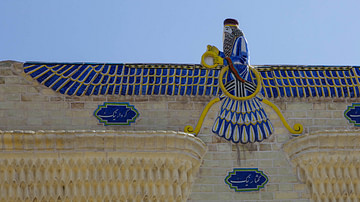
Zarathustra
Zarathustra (also given as Zoroaster, Zartosht, Zarathustra Spitama, l. c. 1500-1000 BCE) was the Persian priest-turned-prophet who founded the religion of Zoroastrianism (also given as Mazdayasna “devotion to Mazda”), the first monotheistic...

Definition
Galatia
Galatia was a region in north-central Anatolia (modern-day Turkey) settled by the Celtic Gauls c. 278-277 BCE. The name comes from the Greek for "Gaul" which was repeated by Latin writers as Galli. The Celts were offered the region by...

Definition
Zakutu
Zakutu (l. c. 728 - c. 668 BCE) was the Akkadian name of Naqi’a, a secondary wife of Sennacherib of Assyria (r. 705-681 BCE). Though she was not Sennacherib's queen, she bore him a son, Esarhaddon, who would succeed him. She may have...

Definition
Horus
Horus is the name of a sky god in ancient Egyptian mythology which designates primarily two deities: Horus the Elder (or Horus the Great), the last born of the first five original gods, and Horus the Younger, the son of Osiris and Isis...

Definition
Upanishads
The Upanishads are the philosophical-religious texts of Hinduism (also known as Sanatan Dharma meaning “Eternal Order” or “Eternal Path”) which develop and explain the fundamental tenets of the religion. The name is translated as...

Definition
Mali Empire
The Mali Empire (1240-1645) of West Africa was founded by Sundiata Keita (r. 1230-1255) following his victory over the kingdom of Sosso (c. 1180-1235). Sundiata's centralised government, diplomacy and well-trained army permitted a...

Article
Tsul'kălû', The Slant-Eyed Giant
Tsul'kălû', The Slant-Eyed Giant is a myth of the Cherokee nation and is among the most popular. The legend relates the story of the great giant, Tsul'kălû', his marriage to a Cherokee maiden, and how the people broke...

Article
Diodorus Siculus' Account of the Life of Semiramis
Semiramis is the semi-divine Warrior-Queen of Assyria, whose reign is most clearly documented by the Greek historian Diodorus Siculus (l. 90-30 BCE) in his great work Bibliotheca Historica ("Historical...
