
Search
Did you mean: Plato?
Remove Ads
Advertisement
Search Results
Definition
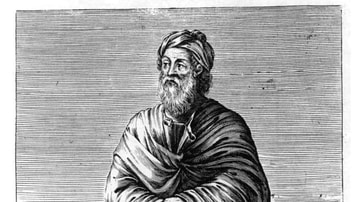
Xenophanes of Colophon
Xenophanes of Colophon (l. c. 570 to c. 478 BCE) was a Greek philosopher born 50 miles north of Miletus, a city famed for the birth of philosophy and home to the first Western philosopher, Thales of Miletus (l. c. 585 BCE...

Definition
Saint Boniface
Saint Boniface (born as Wynfreth, l. 672-754) is one of the most famous saints in the Netherlands. He helped Pope Gregory II (r. 715-731), who was keen to convert pagan Germanic tribes, to achieve his goal, the Christianization...
Definition
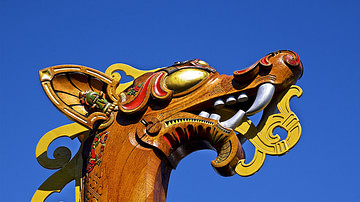
Beowulf
Beowulf is an epic poem composed in Old English consisting of 3,182 lines. It is written in the alliterative verse style, which is common for Old English poetry as well as works written in languages such as Old High German, Old Saxon...

Definition
Chaco Canyon
Chaco Canyon was the center of a pre-Columbian civilization flourishing in the San Juan Basin of the American Southwest from the 9th to the 12th century CE. Chacoan civilization represents a singular period in the history of an ancient...

Definition
Jerusalem
Jerusalem is a major holy city for the three Western traditions of Judaism, Christianity, and Islam. It sits on spurs of bedrock between the Mediterranean Sea and the Dead Sea area. To the north and west, it tapers off to the Jezreel...

Definition
Declaration of Pillnitz
The Declaration of Pillnitz was a joint statement issued on 27 August 1791 by Leopold II, Holy Roman Emperor (r. 1790-1792) and King Frederick William II of Prussia (r. 1786-1797). The declaration appealed to all European...

Definition
Tomb - Home of the Dead
A tomb is an enclosed space for the repository of the remains of the dead. Traditionally tombs have been located in caves, underground, or in structures designed specifically for the purpose of containing the remains of deceased...

Definition
Ereshkigal - Mesopotamian Queen of the Dead
Ereshkigal (also known as Irkalla and Allatu) is the Mesopotamian Queen of the Dead, who rules the underworld. Her name translates as "Queen of the Great Below" or "Lady of the Great Place." She was responsible...

Definition
Moses
Moses (c. 1400 BCE) is considered one of the most important religious leaders in world history. He is claimed by the religions of Judaism, Christianity, Islam, and Bahai as an important prophet of God and the founder of monotheistic belief...

Definition
Cleopatra of Macedon
Cleopatra of Macedon (355/4-308 BCE), daughter of Philip II of Macedon (reign 359-336 BCE) and his Molossian queen, Olympias of Epirus (c. 375-316 BCE), was the only full sister of Alexander the Great (reign 336-323 BCE...
