
Search
Remove Ads
Advertisement
Search Results

Image
Head of a Phoenician Woman
This is a head of woman wearing an Egyptian wig. The hole at the top is a hole for suspension. Part of a baked clay votive figure. The Canaanite traditions of terracotta figurine manufacturer were continued by the Phoenicians...
Image
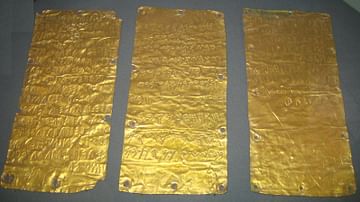
Etruscan & Phoenician Inscriptions
Gold sheet plaques from Pygri, the port of Etruscan Cerveteri. In both the Etruscan and Phoenician alphabet they describe the separation of a space dedicated in the temple there for Astarte. c. 500 BCE (Museo di...

Definition
Baal
Baal (also given as Ba'al) is a Canaanite-Phoenician god of fertility and weather, specifically rainstorms. The name was also used as a title, however, meaning "Lord" and was applied to a number of different deities throughout the ancient...

Definition
Arslan Tash Amulet
Dated to the 7th century BCE, the Arslan Tash amulet (AT1) was discovered in Arslan Tash, Syria and contains the writing of Phoenician, magic incantations. The limestone plaque includes a variety of features: incantations perceived...

Image
Greek Glass Amphoriskos from Amman
An amphoriskos is a small amphora, typically less than 4 inches in height. Polychrome and sand-core formed. The decoration and the technique used are very similar to Phoenician glass, reflecting the trade and cultural...
Image
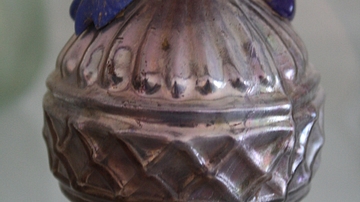
Roman Glass Vase
A Roman glass vase dating from the 1st to 3rd century CE. Glass vessels were often decorated so as to imitate more expensive metalware. (Naxos Archaeological Museum, Greece).
Image
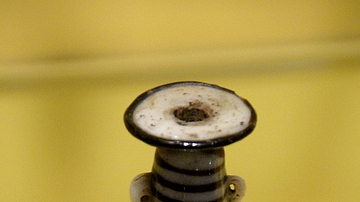
Glass Vessel Made by Core-forming Technique
Core-forming is one of the earliest glass-making techniques. The body of the vessel was shaped around a core. Colored trails of glass were wound around it, and the rim and handles added. the vessel was then...
Image
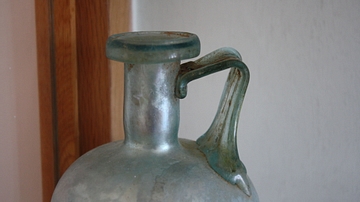
Roman Glass Bottle
A detail of the neck and handle of a Roman glass bottle (1st - 3rd century CE). The handle shows the common technique of adding handles separately and the folding over of the glass at the ends due to the glassmaker's lack of...
Image
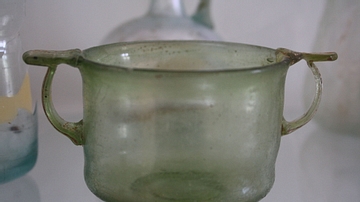
Roman Glass Cup
A Roman glass drinking cup, 1st - 3rd century CE. The shape and carved horizontal handles are typical of glass drinking cups of this period and their use was widespread throughout the Empire, even by those of more modest means...
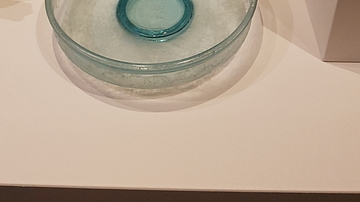
Image
Clear Glass Dish from Pompeii
A clear glass dish from Pompeii. 1st century CE. (Photo taken at the National Maritime Museum, Sydney Australia) According to Pliny, high value was placed on colourless, transparent glass - basically that which...
