
Search
Search Results

Article
Dogen's One Bright Pearl & the Neo-Confucian Pattern
The concept of Oneness is expressed repeatedly in philosophical works both in the east and west. Whether one is reading the Paradoxes of Zeno of Elea (l. c. 465 BCE) or the treatises of Wonyho (l. 617-686 CE) the concept of the One is impossible...

Video
A Short History of Assyria and the Neo-Assyrian Empire
Assyria has a long history, beginning in northern Mesopotamia and then expanding during the Neo-Assyrian Empire from Mesopotamia through Asia Minor, and down through Egypt. The empire began in the city of Ashur and went through many different...
Image
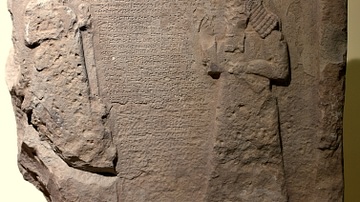
Neo-Assyrian Political Pact Stele, Al-Anbar
Only this fragment of a large stele has survived. On the surface, the Assyrian and Babylonian kings were carved in relief. The cuneiform inscription narrates a political treaty between them. The faces of the kings were deliberately vandalized...

Definition
Sargonid Dynasty
The Sargonid Dynasty was the last ruling house of the Neo-Assyrian Empire from 722-612 BCE, beginning with the reign of Sargon II and ending with fall of the Neo-Assyrian Empire. Some of the most famous kings in the history of Assyria come...

Definition
Library of Ashurbanipal
The Library of Ashurbanipal (7th century BCE) is the oldest known systematically organized library in the world, established in Nineveh by the Neo-Assyrian king Ashurbanipal (r. 668-627 BCE) to preserve the history and culture of Mesopotamia...

Image
Relief of a Neo-Assyrian Queen
Limestone stele fragment depicting a woman looking to the left and wearing a headdress of the royal women. From Kli'eh, near Haditha Dam, Al-Anbar Governorate, Iraq. Neo-Assyrian Empire, 911-612 BCE.
The Iraq Museum, Baghdad.

Definition
Assur
Assur (also Ashur, Anshar) is the god of the Assyrians who was elevated from a local deity of the city of Ashur to the supreme god of the Assyrian pantheon. His attributes were drawn from earlier Sumerian and Babylonian deities and so he...

Image Gallery
A Gallery of Assyrian Warfare
The Assyrian military was the most effective – and feared – fighting force in the Near East, especially during the time of the Neo-Assyrian Empire, 912-612 BCE, when their territory expanded across Mesopotamia, the Levant, into Asia Minor...

Definition
Sennacherib
Sennacherib (r. 705-681 BCE) was the second king of the Sargonid Dynasty of Assyria (founded by his father Sargon II, r. 722-705 BCE). He is one of the most famous Assyrian kings owing to the part he plays in narratives in the biblical Old...

Image
Neo-Assyrian Cuneiform Lexical List
Neo-Assyrian lexical list of names of stones on a clay tablet.
