
Search
Search Results

Article
Mesopotamian Effects on Israel During the Iron Age
The Iron Age in the traditional Ancient Near Eastern chronology ranges from somewhere around 1200 BCE to 333 BCE. It begins from the era when it was first thought iron came to be used up to the ascendency of Alexander the Great as the major...

Definition
Medes
The Medes or Medians were a group of Indo-Iranian-speaking people from central Asia who migrated westwards and entered northern Iran around the end of the 2nd millennium BCE. They settled in the highlands of Zagros (Zagreus in Greek) and...

Definition
Tukulti-Ninurta I
Tukulti-Ninurta I (reigned 1244-1208 BCE) was a king of the Assyrian Empire during the period known as the Middle Empire. He was the son of Shalmaneser I (reigned 1274-1245 BCE) who had completed the work of his father, Adad Nirari I, in...

Definition
Ninurta
Ninurta (identified with Ningirsu, Pabilsag, and the biblical Nimrod) is the Sumerian and Akkadian hero-god of war, hunting, and the south wind. He first appears in texts in the early 3rd millennium BCE as an agricultural god and local deity...

Article
Winning Against the Odds: Sargon II & the Urartu Campaign
It is often when one is faced with the most difficult circumstances that one is given the greatest opportunity for clarity. History provides ample evidence of this experience in showing how, when faced with seemingly impossible situations...

Article
Assyrian reliefs
Mostly dating from the period 880-612 BCE, these carved scenes are found on free-standing stelae and as panels cut on cliffs and rocks at distant places reached by the Assyrian kings during their campaigns. The most spectacular use of stone...

Definition
Tiglath Pileser I
Tiglath Pileser I (reigned 1115-1076 BCE), an Assyrian king of the period known as the Middle Empire, revitalized the economy and the military that had been suffering, more or less, since the death of the king Tukulti Ninurta I (1244-1208...
Image
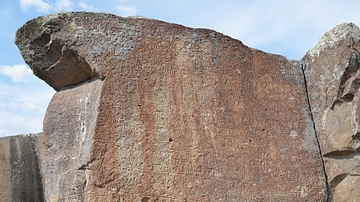
Neo-Hittite Inscription
Neo-Hittite inscription with Luwian hieroglyphs dating back to the 8th century BCE. It is located near Acıgöl in the Nevşehir province in Turkey. It consists of eight lines and commemorates the political and military achievements of King...

Definition
Elam - The Ancient High Country
Elam was a region in the Near East corresponding to the modern-day provinces of Ilam and Khuzestan in southern Iran (though it also included part of modern-day southern Iraq) whose civilization spanned thousands of years from circa 3200 to...

Article
12 Great Cities of Ancient Mesopotamia - The Rise and Fall of the Earliest Cities in the World
The great cities of Mesopotamia ("the land between two rivers") developed prior to the late 4th millennium BCE along two rivers – the Tigris and Euphrates – and were fully established by the Early Dynastic period (circa 2900 to circa 2350/2334...
