
Search
Search Results
Image
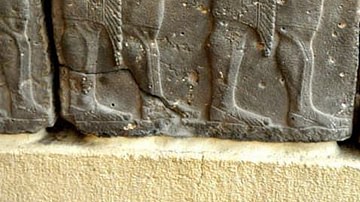
Assyrian Warriors Relief
Basalt reliefs depicting Assyrian warriors of different ranks in procession with a royal chariot led by the commander-in-chief of the Assyrian army. The reliefs were acquired and gathered during the years 1848, 1946, 1948, 1982, and 1995...
Image
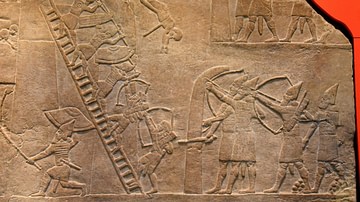
Assyrian Archers Attacking an Egyptian Fortress at Memphis
Detail of a large gypsum wall panel showing the Assyrian army attacking the Egyptian city of Memphis and commemorating the final victory of the Assyrian king Ashurbanipal II over the Egyptian king Taharqa in 667 BCE. Panel 17, Room M of the...

Article
12 Great Cities of Ancient Mesopotamia - The Rise and Fall of the Earliest Cities in the World
The great cities of Mesopotamia ("the land between two rivers") developed prior to the late 4th millennium BCE along two rivers – the Tigris and Euphrates – and were fully established by the Early Dynastic period (circa 2900 to circa 2350/2334...
Image
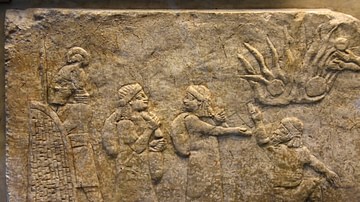
Assyrian Relief Showing Babylonian Prisoners
Assyrian alabaster panel showing Babylonian prisoners in a camp, from the North Palace at Nineveh, Northern Mesopotamia, modern-day Iraq, Neo-Assyrian Empire, reign of Ashurbanipal II, 668-630 BCE. To the left, an Assyrian soldier stands...
Image
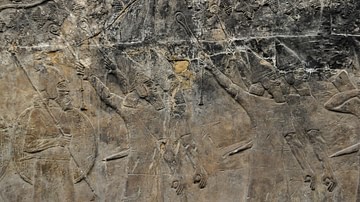
Assyrian Slingers Attacking the City of -alammu
Assyrian relief depicting a siege, from Room XIV, the South-West Palace at Nineveh, Mesopotamia, modern-day Iraq, Neo-Assyrian Empire, reign of Sennacherib, 700-692 BCE. The attack starts with slingers hurling stones towards the enemy at...

Article
History of Assyria
The foundation of the Assyrian dynasty can be traced to Zulilu, who is said to have lived after Bel-kap-kapu (c. 1900 BCE), the ancestor of Shalmaneser I. The city-state of Ashur rose to prominence in northern Mesopotamia, founding trade...
Image
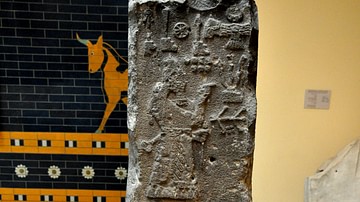
Stela of the Assyrian King Adad Nirari III
Stela of Adad Nirari III, erected by one of the king's local governors, Nergal-Eres, found in Saba, Neo-Assyrian Empire, 810-783 BCE. The stela features the Assyrian King Adad Nirari III praying in front of god symbols, and the inscriptions...
Image
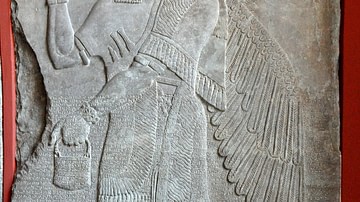
Assyrian Protective Spirit, Nimrud
Alabaster bas-relief, depicting a standing human-headed genie or sage, from the North-West Palace of Ashurnasirpal II at Nimrud, Mesopotamia, modern-day Iraq. Neo-Assyrian Empire, 9th century BCE. Apkallu, a protective spirit, protects the...

Article
The Greatest Party Ever Thrown: Ashurnasirpal II’s Kalhu Festival
The greatest party ever thrown in antiquity is the inaugral event thrown by Ashurnasirpal II (r. 884-859 BCE) in 879 BCE at the completion of his new city of Kalhu which was attended by almost 70,000 people who were served, among other treats...

Image
High-Ranking Assyrian Officials
An almost 3-meter-high alabaster bas-relief depicting four high-ranking Assyrian officials or dignitaries, stepping forward to greet the Assyrian king, Sargon II. From the Royal Palace of Sargon II at Khorsabad, in modern-day Nineveh Governorate...
