
Search
Search Results
Image
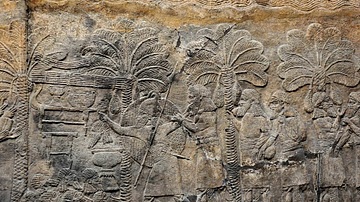
Assyrian Military Campaign in Southern Iraq
This wall panel was part of a large alabaster wall relief. The Assyrian king in a chariot (who is noy shown) watches as prisoners are brought in, and heads and booty are piled-up in a palm grove. In Assyrian literature, beheaded bodies refer...

Image
Assyrian Doorway Protective Spirit
Protective spirit (one of a pair) in the guise of a royal figure with cloak and mantle. It guarded the doorway into the Temple of Ninurta (chief god of the city of Nimrud and Assyrian god of war and farming) in Nimrud. The temple itself was...

Definition
Kalhu / Nimrud
Kalhu (also known as Caleh, Calah, and Nimrud, in modern-day northern Iraq) was a city in ancient Mesopotamia that became the capital of the Assyrian Empire under Ashurnasirpal II (r. 884-859 BCE) who moved the central government there from...
Image
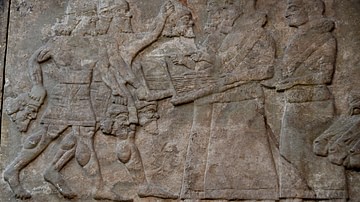
Decapitated Heads of Assyrian Enemies
Alabaster bas-relief showing Assyrian soldiers holding the decapitated heads of their defeated enemy before Assyrian musicians. Neo-Assyrian Period, 865-860 BCE. Detail of Panel 6 (top), Room B, the North-Palace Palace, Nimrud, modern-day...

Image
Decapitated Soldier, Assyrian Relief
Alabaster bas-relief sowing a beheaded soldier; he was an Assyrian enemy. An Assyrian cavalry is passing over him. Neo-Assyrian Period, 865-860 BCE. Detail of Panel 9 (top), Room B, the North-Palace Palace, Nimrud, modern-day Iraq. (The British...
Image
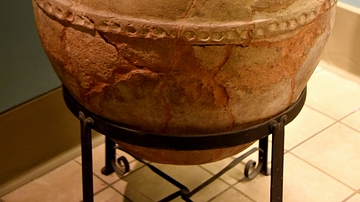
Assyrian Storage Jar
This jar was found in one of the wine-cellars in the arsenal at Nimrud (ancient Kalhu). It is marked in cuneiform with its capacity; 1 homer, 3 seah, 7 qa. In fact, it holds about 300 liters. Assyrian, late 7th century BCE. From Nimrud, Mesopotamia...
Image
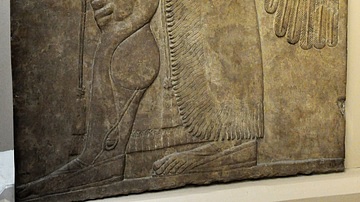
An Assyrian Apkallu Carrying a Goat
This alabaster bas-relief depicts a human-headed and winged man, Apkallu or Sage, carrying a goat. He wears a sandal carries a goat with his left arm and what appears to be a palm branch in his right hand. Note the prominent muscular and...
Image
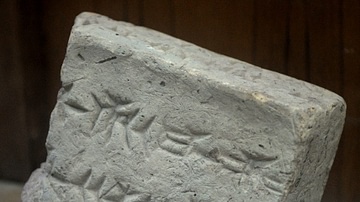
Assyrian Cuneiform Brick
The cuneiform inscriptions on this mud-brick mention the name of Ashurnasirpal II, the Assyrian king. From northern Mesopotamia, modern-day Iraq. Neo-Assyrian period, reign of Ashurnasirpal II, 883-859 BCE. The Sulaymaniyah Museum, Iraq.
Image
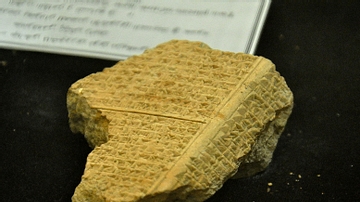
Fragment of an Assyrian Prism
Only this fragment of a large Assyrian terracotta prism has survived. From Mesopotamia, modern-day Iraq. Neo-Assyrian period. 8th and 7th centuries BCE. The Sulaimaniya Museum, Iraq.
Image
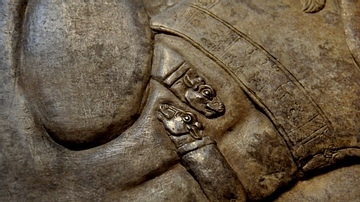
Assyrian Armlet
A close-up view of the right arm of a human-headed and winged protective spirit, Apkallu (or Sage). There is an armlet which embraces the right biceps muscle. The armlet's ends are sheep-headed. Note the decorations on the lower end of the...
