
Search
Remove Ads
Advertisement
Search Results

Definition
Hetaira
A hetaira (pl. hetairai) was an educated female prostitute in ancient Greece and a common participant in symposia or drinking parties in private homes. Sometimes referred to in English as a courtesan, the Greek term hetaira was a euphemism...
Definition
Kikuyu People
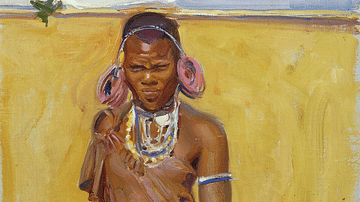
The Kikuyu people (aka Gikuyu or Agikuyu) are a Bantu-speaking people who occupied territory in what is today central Kenya in East Africa from the 17th century onwards. They established themselves primarily as agriculturalists...

Definition
Aztec Art
The Aztec culture, centred at the capital of Tenochtitlan, dominated most of Mesoamerica in the 15th-16th centuries. With military conquest and trade expansion, the art of the Aztecs also spread, helping the Aztec civilization achieve...
Definition
Bellerophon
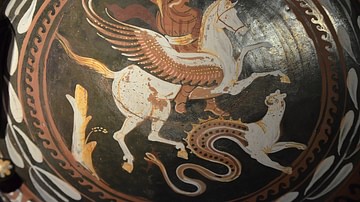
Bellerophon (aka Bellerophontes) is the Corinthian hero of Greek mythology who famously battled and killed the fantastical Chimera monster, a fearsome fire-breathing mix of lion, goat, and snake. Bellerophon was the son of Poseidon...

Definition
Ashur - The First Great Assyrian City
Ashur (also known as Assur) was an Assyrian city located on a plateau above the Tigris River in Mesopotamia (today known as Qal'at Sherqat, al-Shirqat District, northern Iraq). The city was an important center...

Definition
Scylla and Charybdis - The Monsters Who Guarded Sicily
Scylla and Charybdis were monsters from Greek mythology thought to inhabit the Straits of Messina, the narrow sea between Sicily and the Italian mainland. Preying on passing mariners, Scylla was a...

Definition
Terracotta Army
The Terracotta Army refers to the thousands of life-size clay models of soldiers, horses, and chariots which were deposited around the grand mausoleum of Shi Huangdi, first emperor of China and founder of the Qin dynasty, located...

Definition
Mali Empire
The Mali Empire (1240-1645) of West Africa was founded by Sundiata Keita (r. 1230-1255) following his victory over the kingdom of Sosso (c. 1180-1235). Sundiata's centralised government, diplomacy and well-trained army permitted a...

Article
Greek vases: names, shapes and functions
The system of names used today for Greek vases has quite rightly been described by one leading scholar as 'chaotic'. Many of the names were first applied in the eighteenth and nineteenth centuries by scholars...

Definition
Thersites
Thersites is a character in the Iliad who made a stand against Agamemnon and the enterprise of the Trojan War. Homer chose to add Thersites’ speech after Achilles’ infamous dispute with Agamemnon, probably to emphasize the struggles...
