
Search
Remove Ads
Advertisement
Search Results

Image
Pottery Figurine from Tell al-Sa'idiyya
This is the upper half of a female figurine. Her facial features, hair, and necklace were carefully made in spite of being small in size. The breasts are prominent. Late Bronze Age, 1550-1200 BCE. From Tell...

Image
Moche Pottery Portrait
From the Apogee Epoch (c. 1 CE - 800 CE). Housed at the Museo Larco, Lima, Peru
Image
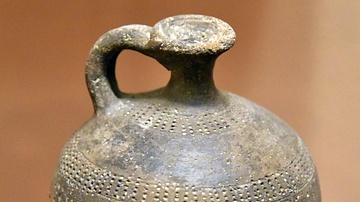
Black Pottery Juglet from Jordan
These distinctive small juglets belong to the "Tell el-Yahudiyeh Ware", named after the Egyptian site where they were first discovered, although this type of ware was produced elsewhere. The juglets are of a dark...
Image
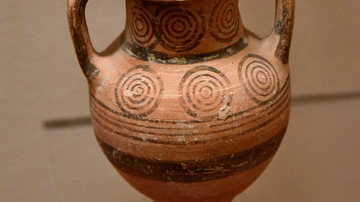
Cypro-Phoenician Pottery Vessel
This vessel belongs to a ceramic tradition known as "black-on-red" ware, the most ubiquitous of the Iron Age's Cypro-Phoenician exports. Iron Age II, 1000-539 BCE. From Amman, Jordan. (The Jordan Museum, Amman, Jordan...

Image
Meroitic Pottery Flask
This is a red burnished globular flask with a wide mouth. The flask has been incised with decoration of horizontal bands at the neck and shoulder above an impressed design of triangles. From cemetery 300 at Meroe, Sudan...
Image
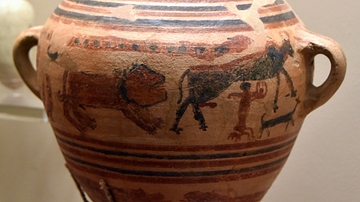
Pottery Jar Showing a Myth from Tell Zar'a
Lare jar painted in red and black on beige. The paintings show animal scenes in two registers. In the lower register, two large snakes lie opposite each other. In the upper one, framed by horizontal lines...

Image
Pottery Ossuary from Azor
Chests of this sort were used to contain the bones of individuals in secondary burials. These were burials in which the body had been exposed and allowed to decay before the bones were gathered. At Azor, on the coast of...
Image
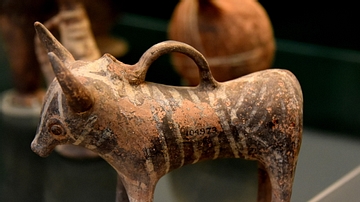
Imported Cypriot Pottery Bull to the Levant
During the Late Bronze Age, the trade contacts established with Cyprus in the preceding period were intensified. This type of bull was very popular in the Levant, either as ornaments or perhaps as feeding...

Image
Stamped Pottery Jar from Tell al-Khulayfi
An oval seal impression repeated on the rim and handles of a large jar. Seal impressions are official guarantees of the jars and their contents; therefore, stamped jars indicated the presence of a local administrative...

Image
Ammonite Pottery Bottle
Carrot-shaped bottle, burnished and decorated with horizontal bands. This characteristic type was probably made for special liquids, such as cosmetics or medicinal oils. Locally made in an Assyrian form, such bottles link...
