
Search
Remove Ads
Advertisement
Search Results

Definition
Skara Brae
Skara Brae is a Neolithic Age site, consisting of ten stone structures, near the Bay of Skaill, Orkney, Scotland. Today the village is situated by the shore but when it was inhabited (c.3100-2500 BCE) it would have been further inland...

Definition
Perfection of Wisdom
Perfection of Wisdom is the foundational text of the Mahayana Buddhist school, a kind of anthology of works, thematically linked, composed between c. 50 BCE - c. 600 CE in India by Mahayana Buddhist scribes. It is comprised...

Definition
Inca Architecture
Inca architecture includes some of the most finely worked stone structures from any ancient civilization. Inca buildings were almost always practical and pleasing to the eye. They are also remarkably uniform in design with even...

Definition
Maya Religion
Maya religious beliefs are formed on the notion that virtually everything in the world contains k'uh, or sacredness. K'uh and k'uhul, similar terms which are used to explain the spirituality of all inanimate and animate things...
Definition
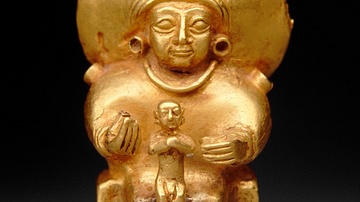
Sauska - The Hurrian's Radiant Goddess of Fertility and War
Sauska (also known as Shaushka, Sausga, and Anzili) was the Hurrian-Hittite goddess of fertility, war, and healing. She was worshipped throughout the region known as Hanigalbat (present day Iraq...

Definition
Druid
Druids were a class of individuals in ancient Celtic cultures known for their great wisdom and knowledge of traditions. Not only priests who managed all religious rituals such as sacrifices (including humans), druids were able to give...

Definition
Silla
The Silla kingdom ruled south-eastern Korea during the Three Kingdoms period from the 1st century BCE to 7th century CE. The capital was Geumseong (Gyeongju) with a centralised government and hierarchical system of social ranks. The prosperity...
Definition
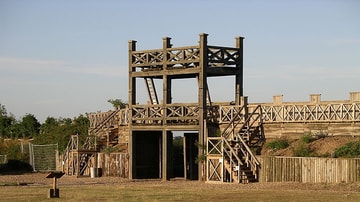
Roman Fort
The Roman army constructed both temporary and permanent forts and fortified military camps (castrum) across the frontiers of the empire's borders and within territories which required a permanent military presence to prevent indigenous...
Definition
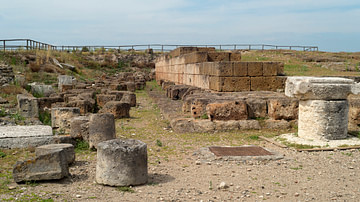
Vulci
Vulci (Velch) was an Etruscan city located 12 km from the western coast of central Italy by the banks of the Fiora River. Flourishing as a trading port between the 6th and 4th century BCE, it was an important member of the Etruscan League...

Definition
Ehecatl
Ehecatl was a Mesoamerican god of air and winds, especially those which brought rains. Regarded as a manifestation of the great feathered serpent god Quetzalcoatl, he was sometimes known as Quetzalcoatl-Ehecatl, in which guise he helped...
