
Search
Remove Ads
Advertisement
Search Results

Image
Boundary Marker with an Official Inscription from Chalkidiki
Inscribed stone boundary marker from Chalkidiki, c.350 to 300 BCE. Archaeological Museum of Thessalonika. It is an example of ancient Greek boundary markers, known as horoi, and it contains...
Article
The Grand Strategy of Classical Sparta
In ancient Lacedaemon, as in all enduring political communities, there was a symbiotic relationship between the form of government chosen, the way of life that this form of government fostered, and the grand...

Article
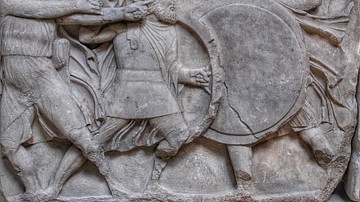
The Legacy of Charles Martel & the Battle of Tours
The Battle of Poitiers aka the Battle of Tours took place over roughly a week in early October of 732. The opposing sides consisted of a Frankish army led by Charles Martel (r. 718-741) against an invading...
Article
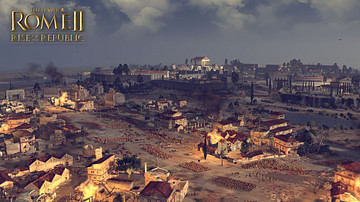
The Sack of Rome by the Gauls, 390 BCE
After the Gauls defeated the Romans at the confluence of the Tiber and the Allia rivers, the Gauls marched on to Rome. In late July 390 BCE, the undefended city fell to the invaders to be burnt and sacked. Only...

Image
Curse Tablet from Pella, Ancient Kingdom of Macedonia
Pella curse tablet, lead scroll, first half of the 4th century BCE. Writing and dedicating a curse tablet (katadesmos) was an act of practical magic in the Greco-Roman world. Curse tablets were fragmental...

Image
Alexander the Great’s Eight Bodyguards - The Somatophylakes and the Macedonian Empire
Under Philip II of Macedon (reign 359–336 BCE) and Alexander the Great (reign 336–323 BCE), the somatophylakes (“bodyguards”) formed an exceptionally exclusive circle of trusted...

Video
Olympias: Mother to Alexander the Great and Second Wife of Phillip II of Macedon
Olympias, born with the name Myrtle, was the daughter of Neoptolemus, the king of Epirus, which was a Greek kingdom southwest of Macedonia and became the second wife of Philip...
Image
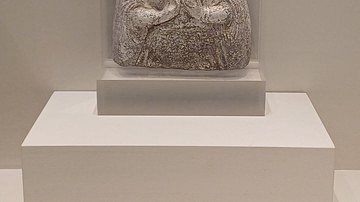
Terracotta Bust of an Underworld Goddess from Pella
Terracotta bust of an underworld goddess from Pella, mid-4th century BCE. Archaeological Museum of Pella, North Macedonia. The ancient city of Pella, the second capital of the ancient Kingdom of Macedonia...
Image
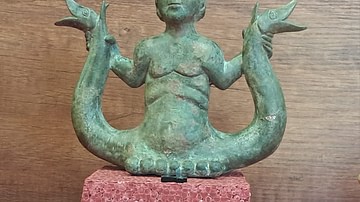
Bronze Figurine of Infant Hercules Killing Serpents
Bronze figurine of infant Hercules killing serpents, from Herakleia Lynkestis, near modern Bitola, Macedonia. Archaeological Museum of Heraclea, Bitola. The city was founded by Philip II of Macedon...
Members

Video
Lecture #6: Alexander the Great & His Powerful Sisters
Historian Nathalie Choubineh delves into the life and legacy of Alexander the Great—from his royal Macedonian roots and military conquests to the political power struggles that followed. This video...
