
Search
Did you mean: Boreas?
Remove Ads
Advertisement
Search Results
Definition
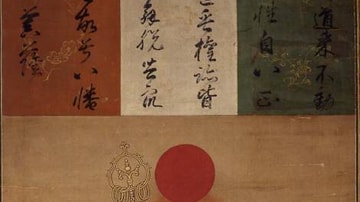
Hachiman - Origin of the Kamikaze Wind
Hachiman is the ancient Shinto god or kami of war, divination, and culture. He is famously credited with sending the kamikaze or 'divine wind' which twice dispersed the invading fleets of Mongol ruler Kublai Khan in the 13th century CE. This...

Definition
Taejo of Goryeo
Taejo (r. 918-943 CE), previously known as Wang Geon or Wang Kon, was the founder and first king of the Goryeo (Koryo) kingdom which unified and ruled ancient Korea from 918 CE to 1392 CE. Wang Geon was given the posthumous title of Taejo...

Definition
Hwarang
The hwarang was a state-sponsored organisation for the education of elite young males in the ancient kingdom of Silla, Korea. Variously translated as the 'Flower Boys,' 'Flowering Youth,' or 'Elite Youth' (and sometimes, too, the rather misleading...

Definition
Khitan
The Khitan people formed the Liao dynasty and ruled parts of Mongolia, Manchuria, and northern China from 907 to 1125 CE. Adopting elements of Chinese government and culture, the Khitan were more than a match for their rivals the Song dynasty...

Definition
Later Three Kingdoms Period
The Later Three Kingdoms period (889-935 CE) of ancient Korea saw a partial revival of the old three kingdoms which had dominated the peninsula from the 1st century BCE to the 7th century CE. After the Unified Silla kingdom had ruled Korea...

Definition
Kim Yu-sin
Kim Yu-sin (aka Kim Yushin, 595-673 CE) was a general of the Silla kingdom which ruled south-eastern Korea during the Three Kingdoms Period. Kim would greatly help Silla unify Korea, famously leading a massive army to crush the rival kingdom...
Image
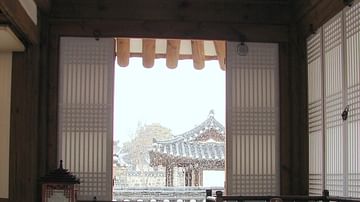
Hanok Interior
An interior room of a traditional Korean home in the hanok style of Korean architecture. (Namsangol Hanok Village, Seoul, South Korea)

Article
The Mongol Invasions of Japan, 1274 & 1281 CE
The Mongol invasions of Japan took place in 1274 and 1281 CE when Kublai Khan (r. 1260-1294 CE) sent two huge fleets from Korea and China. In both cases, the Japanese, and especially the samurai warriors, vigorously defended their shores...

Article
Sources of History
History (from the Greek ἱστορία, meaning 'a learning or knowing by inquiry') can be broadly taken to indicate the past in general but is usually defined as the study of the past from the point at which there were written sources onwards...

Article
Ancient History Encyclopedia in Japan
The “Ancient Japan” initiative at Ancient History Encyclopedia arose as there is a dearth of open access and digitally curated information concerning early Japanese history available online and in English. East and Southeast Asia are arguably...
