
Search
Did you mean: Boreas?
Remove Ads
Advertisement
Search Results

Definition
Gojoseon
Gojoseon (Gochoson or Old Choson) was an ancient kingdom which ruled northern Korea in the second half of the first millennium BCE. Gojoseon possessed the most advanced culture in the Korean peninsula at that time and was an important marker...

Article
Confucianism in Ancient Korea
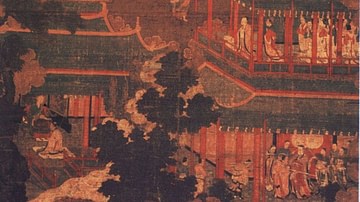
Principles of Confucianism were adopted by successive dynasties and kingdoms in ancient Korea, and the study of classic Confucian texts was an important part of education and entrance examinations for the state administration. Confucianism...
Definition
Goryeo
Goryeo (Koryo) ruled Korea from 918 to 1392. The kingdom oversaw an unprecedented flourishing in culture and arts with developments in architecture, ceramics, printing, and papermaking. The kingdom was repeatedly invaded by the Mongols in...

Definition
Wonhyo
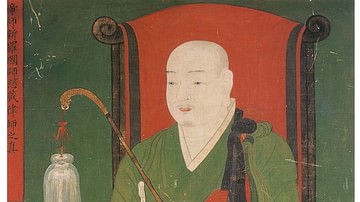
Wonhyo (l. 617-686 CE) was a Korean Buddhist philosopher whose works impacted a wide array of later philosophers and writers through his teaching that one’s interpretation of the world created one’s reality. He is highly regarded as the greatest...
Article
Famous Buddhist Monks of Ancient Korea
Throughout ancient Korea's history Buddhist monks were a particularly important element of state and religious affairs. From the 4th century CE onwards, in the Three Kingdoms period, they were members of a select section of society which...
Article
Shamanism in Ancient Korea
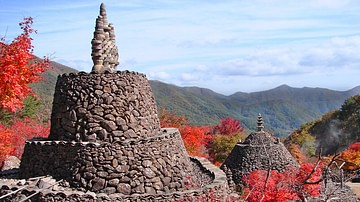
Shamanism was widely practised in Korea from prehistoric times right up to the modern era. It is a belief system which originated in north-east Asian and Arctic cultures, and although the term shamanism has since acquired a wider meaning...

Definition
Toyotomi Hideyoshi - Unifier of Japan
Toyotomi Hideyoshi (1537-1598) was a Japanese military leader who, along with his predecessor Oda Nobunaga (1534-1582) and his successor Tokugawa Ieyasu (1543-1616), is credited with unifying Japan in the 16th century. Hideyoshi rose from...

Definition
Asuka Period
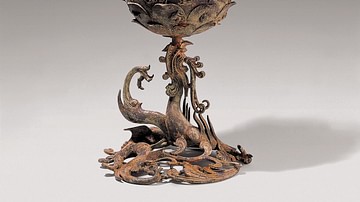
The Asuka Period (Asuka Jidai) of ancient Japan covers the period from 538 CE to 710 CE and, following on from the Kofun Period (c. 250-538 CE), so constitutes the latter part of the Yamato Period (c. 250-710 CE). For some scholars the period...
Definition
Baekje
Baekje (Paekche) was one of the Three Kingdoms which ruled over ancient Korea from the 1st century BCE to the 7th century CE. Controlling territory in the south-western part of the peninsula the kingdom was in constant rivalry with the other...

Definition
Queen Seondeok
Queen Seondeok (Sondok) ruled the ancient kingdom of Silla from 632 to 647 CE and was the first female sovereign in ancient Korea. Silla was on the verge of dominating the whole of the Korean peninsula and Seondeok helped progress her kingdom...
