
Search
Did you mean: Kish?
Remove Ads
Advertisement
Search Results
Image
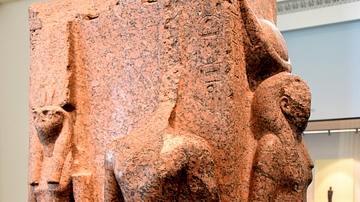
Sculpture of King Thutmose III
This is a rare example of an Egyptian temple sculpture, in which the figures face in 4 different directions. This suggests that it stood in the middle of a room. Three persons are represented twice. King Thutmose III...

Image
Silver Coin of the Parthian King of Kings Farhad IV
This coin (obverse) shows "King of the Kings" Farhad (Phraates) IV, reigned 38-2 BCE, in the presence of a goddess holding a horn of plenty (cornucopia); reverse, not shown. On Parthian coins, goddesses...
Image
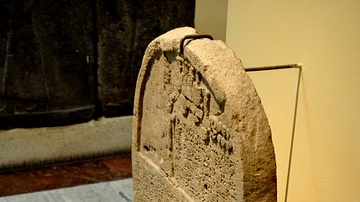
Stele of King Sennacherib
This stele was made of limestone and was found in Nineveh. On the relief, the Assyrian king Sennacherib prays in front of divine symbols and Gods. It records the king's achievements and expansion of his royal capital...

Image
Mud Brick Stamped with the Name of King Ishme-Dagan
This baked-mud brick was stamped with the name of king Ishme-Dagan; he was the 4th king in the First Dynasty of Isin and son of Iddin-Dagan. From Ur, southern Mesopotamia, Iraq. Isin-Larsa period...
Image
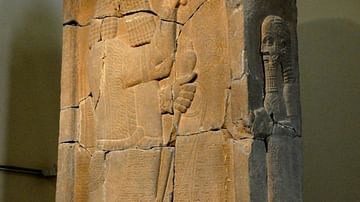
Sam'al Stele of King Esarhaddon
This commemorative basalt stele depicts the Assyrian king Esarhaddon worshiping gods and symbols of gods. The king's left hand holds a royal mace and two ropes. These ropes pass through the lips of two captives. The...
Image
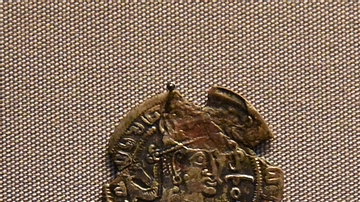
Coin of King Tigin
When General Jean-Baptiste Ventura opened the Buddhist monument (stupa) at Manikyala in 1830 CE, he found a coin depicting Tigin, a king of Kabul. The presence of the coin shows that the stupa was still being used in 700 CE...

Image
Assyrian Courtiers Carrying the King's Throne
This gypsum wall panel depicts a procession of Assyrian courtiers and eunuchs carrying the King's throne; only the anterior part of the decorated throne's pole survives. This scene represents a remarkable...
Image
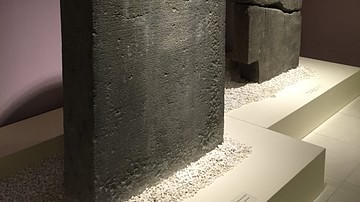
Tablets with King Nabonidus Inscriptions, Harran
These large tablets comes from the 6th-5th century BCE. They contain the inscriptions from King Nabonidus, who was the last king of the Neo-Babylonian Empire, reigning from 556–539 BC. These tablets were...

Image
The King's Mother Tasherenese
The cobras on Tasherenese's headdress and forehead signal a royal status, and her fly-whisk was typical of queens. She was, however, not a queen. An inscription on the back-pillar identifies her as the mother of King...
Image
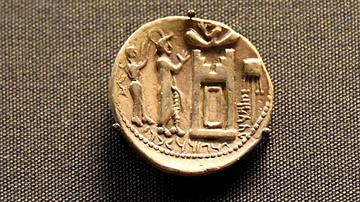
Vadfradad I, King of Persis
This coin depicts Vadfradad I, king of Persis (Fars) in Southern Iran, who can be identified on both sided of the coin by his special headgear. On the back (this image), a figure holds up a royal headband (diadem) as...
