
Search
Remove Ads
Advertisement
Search Results
Definition
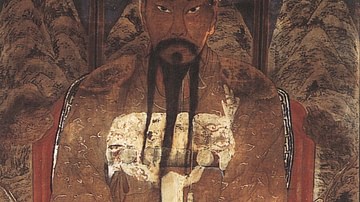
Dangun
Dangun Wanggeom (or Tangun) was the legendary founder of Gojoseon (Gochoson or Old Choson), the first Korean state which ruled northern Korea in the second half of the first millennium BCE. Gojoseon possessed the most advanced culture...

Definition
The Hittites
The Hittites occupied the ancient region of Anatolia (also known as Asia Minor, modern-day Turkey) prior to 1700 BCE, developed a culture apparently from the indigenous Hatti (and possibly the Hurrian) people, and expanded their...

Definition
Alexander Selkirk - The Inspiration For Robinson Crusoe
Alexander Selkirk (or Selcraig, 1676-1721) was a Scotsman famously marooned for four years and four months on a desert island in the Pacific Ocean until his rescue by a passing British ship in February...

Definition
Assembly of Notables of 1787
The meeting of the Assembly of Notables in 1787 was a last-ditch effort by the ministers of King Louis XVI of France (r. 1774-1792) to fix the disastrous condition of French finances. The assembly failed to agree on...

Definition
Charles I of England
Charles I of England (r. 1625-1649) was a Stuart king who, like his father James I of England (r. 1603-1625), viewed himself as a monarch with absolute power and a divine right to rule. His lack of compromise with Parliament...

Definition
Medes
The Medes or Medians were a group of Indo-Iranian-speaking people from central Asia who migrated westwards and entered northern Iran around the end of the 2nd millennium BCE. They settled in the highlands of Zagros (Zagreus in Greek...
Definition
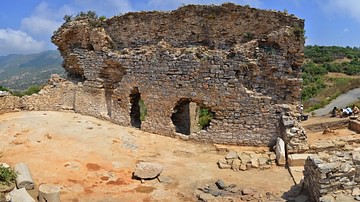
Antiochia ad Cragum
Antiochia ad Cragum (“Antioch on the Cliffs” or “Antioch at Cragus”) was a Hellenistic Roman city located in Cilicia Trachea (“Rough Cilicia”, also known as Cilicia Aspera and Cilicia Secunda) on the southern coast of modern-day...

Definition
Ancient Greek Dance
In ancient Greece, dance had a significant presence in everyday life. The Greeks not only danced on many different occasions, but they also recognized several non-performative activities such as ball-playing or rhythmic physical...

Definition
Byzantine Empire
The Byzantine Empire existed from 330 to 1453. It is often called the Eastern Roman Empire or simply Byzantium. The Byzantine capital was founded at Constantinople by Constantine I (r. 306-337). The Byzantine Empire varied in...

Definition
Ereshkigal - Mesopotamian Queen of the Dead
Ereshkigal (also known as Irkalla and Allatu) is the Mesopotamian Queen of the Dead, who rules the underworld. Her name translates as "Queen of the Great Below" or "Lady of the Great Place." She was responsible...
