
Search
Remove Ads
Advertisement
Search Results

Definition
Ajanta
Approximately 67 miles (107 km) to the north of Aurangabad in the Indhyadri range of Western Ghats lie the caves of Ajanta. The 30 caves, famous for their early Buddhist temple architecture and many delicately drawn murals, are located...

Definition
Black Kettle
Black Kettle (Mo-ta-vato/Mo'ohtavetoo'o, l. c. 1803-1868) was a chief of the Southern Cheyenne who became famous as a "peace chief" – seeking peaceful relations with the US government – as opposed to war chiefs such as Roman Nose...

Definition
Underground Railroad - Pathways to Freedom
The Underground Railroad was a decentralized network of White abolitionists, free Blacks, former slaves, Mexicans, Native Americans, and others opposing slavery in the United States who established secret routes...
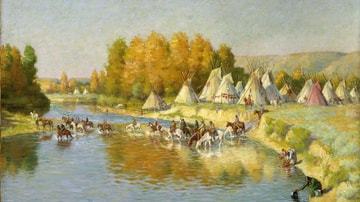
Article
Ten North American Native Facts You Need To Know
The history and culture of the Native Peoples of North America are often overlooked as they have been largely eclipsed by the history of the European settlers who colonized the region beginning in the...

Article
Food & Agriculture in Ancient Greece
The prosperity of the majority of Greek city-states was based on agriculture and the ability to produce the necessary surplus which allowed some citizens to pursue other trades and pastimes and to create a quantity...

Image
The Twelve Longest Discovery Expeditions in the Age of Sail - Exploration, Science, and the Expansion of Global Knowledge
The Age of Sail (c. 1400–1860) produced some of history’s longest exploratory and scientific expeditions, driven by trade, imperial rivalry, navigation...

Definition
William Howe
Sir William Howe (1729-1814) was a British military officer and politician, most notable for his role as commander-in-chief of the British army during the initial years of the American Revolutionary War (1775-1783). Despite several...

Definition
Seven Years' War - The 18th-Century World War
The Seven Years' War (1756-1763) was a global conflict fought between the great powers of Europe in the mid-18th century. The culmination of several decades of conflict, it was caused both by colonial rivalries...

Article
Siege Warfare in Ancient India
Forts and sieges held a key position in ancient Indian warfare. Built on considerations of strategic location, topography, and the natural advantages provided by the site, forts would be heavily supplemented with man-made...

Article
Social, Political & Economic Landscapes in Kautilya's Arthashastra
The Arthashastra (or Arthaśāstra) is one of the oldest surviving treatises on statecraft. There is considerable debate about the dating and authorship of the text; it underwent compilation...
