
Search
Remove Ads
Advertisement
Search Results

Article
Louis XVI, the Girondins, & the Road to Revolutionary War (1791-92)
On 20 April 1792, King Louis XVI of France (r. 1774-1792) stood before the Legislative Assembly and, with a faltering voice, read a declaration of war against Austria, to the ecstatic delight...

Video
The Rise and Fall of the Inca Empire: A Short History
The Inca civilisation flourished in Peru and surrounding areas between 1400 and 1533 CE. Prior to the Inca being dominant in Western South America, the Chimu occupied the area until 1470 when the...
Definition
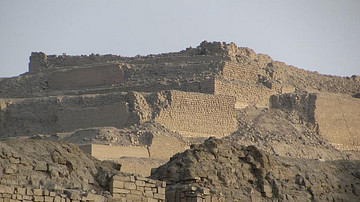
Pachacamac
Pachacamac, located on the coast of Peru and 32 km south of Lima, was an important sacred site, oracle, and place of burial, which was visited by pilgrims of many ancient Andean cultures, including the Incas. The site, active for...

Image
Pachacuti Inca Yupanqui
A statue of Inca ruler Pachacuti Inca Yupanqui (r. 1438-71 CE) in Plaza de Armas, Cuzco, Peru

Image
Map of the Inca Empire (Tawantinsuyu, c. 1438–1533) - Expansion Across South America, Cities and Roads
The Inca Empire (Tawantinsuyu, c. 1438–1533) grew from a highland kingdom centered on Cusco into the largest empire in pre-Columbian America. Under Pachacuti...

Definition
Repartimiento
The repartimiento system was a distribution of rights to Spanish colonialists and municipalities, which allowed them to extract forced but low-paid labour from local communities in conquered territories. Designed to replace the...
Image
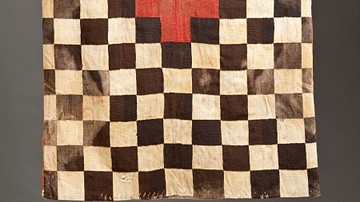
Inca Military Tunic
The standard military tunic of the Inca civilization, c. 1400 and 1533 CE. In Inca art black represented death and red represented blood and conquest. (Los Angeles County Museum of Art, L.A.)

Video
Inca ushnus: landscape, site and symbol in the Andes
For three years, a research team from the British Museum, the University of Reading, Royal Holloway University of London and the Universidad Nacional de San Cristobal de Huamanga set out to discover...

Definition
Civilization - From Nomadic Life to the Farm and City
Civilization (from the Latin civis=citizen and civitas=city) is a term applied to any society which has developed a writing system, government, production of surplus food, division of labor, and urbanization...

Image
Inca Gold Sun Mask
A gold-sheet mask representing the sun god Inti from the La Tolita part of the Inca empire. The design is typical of masks of Inti with zig-zag rays bursting from the head and ending in human faces or figures. (National Museum...
