
Search
Remove Ads
Advertisement
Search Results

Article
Hei Tiki
The hei tiki is a small personal adornment, fashioned by hand from tough pounamu (New Zealand greenstone or nephrite jade), and is worn around the neck. Hei means something looped around the neck, and tiki is a generic word used throughout...

Article
The Ajanta Caves
The 30 caves at Ajanta lie to the north of Aurangabad in the Indhyadri range of Western Ghats. The caves, famous for their temple architecture and many delicately drawn murals, are located in a 76 m high, horseshoe-shaped escarpment overlooking...
Article
Buddhism in Ancient Korea
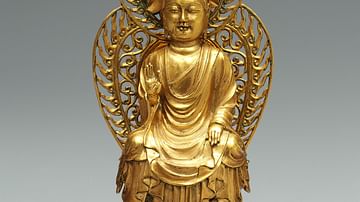
Buddhism, in Korean Bulgyo, was introduced by monks who visited and studied in China and then brought back various Buddhist sects during the Three Kingdoms period. It became the official state religion in all Three Kingdoms and subsequent...
Article
A Model of Christian Charity and the City on a Hill
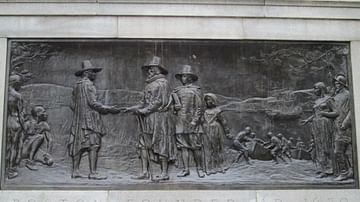
A Model of Christian Charity is a sermon delivered by the Puritan John Winthrop (l. c. 1588-1649 CE), second governor of the Massachusetts Bay Colony, either just before or after his ship, the Arbella, set sail from England for North America...

Article
Hymn to Nisaba
The Hymn to Nisaba (c. 3rd millennium BCE) is a poem praising Nisaba, the Sumerian goddess of writing and accounts who also served as scribe of the gods. The poem is officially dedicated to Enki, the god of wisdom (sometimes given as her...

Article
Celtic Brooches - The Jewellery of the Ancient Celts
Ancient and medieval Celtic cultures produced many forms of jewellery, and one distinctive category is their brooches, fibulae, and pins. Without zips and buttons, brooches were used to close items of clothing, to create a pleasing or fashionable...

Article
Top 5 Must-See Historical Sites in Dublin
Dublin has much to offer in cultural and historical experiences. It is a vibrant and colorful city, with a history dating back many centuries. Dublin has it all - from castles and a Viking harbor to ancient pubs, medieval libraries, and more...

Article
Exsurge Domine
Exsurge Domine (“Arise, O Lord” in Latin) is a papal bull issued 15 June 1520 by Pope Leo X (served 1513-1521) condemning Martin Luther’s 95 Theses as heresy along with any other works by Luther or those who supported him. Luther burned the...

Article
Byzantine Monasticism
Monasticism, that is individuals devoting themselves to an ascetic life in a monastery for devotional purposes, was an ever-present feature of the Byzantine empire. Monasteries became powerful landowners and a voice to be listened to in imperial...

Article
The Megalithic Temples of Malta
The megalithic temples of Malta and Gozo rank amongst the oldest free-standing buildings in the world. Construction of these temples started c. 3500 BCE, an impressive architectural feat for their time, particularly given that the builders...
