
Search
Remove Ads
Advertisement
Search Results

Article
Shulgi and Ninlil's Barge - A Poem Celebrating a Divine Event
Shulgi and Ninlil's Barge is a Sumerian poem dated to the reign of Shulgi of Ur (2094 - circa 2046 BCE) celebrating the caulking of the barge of the goddess Ninlil, consort of the sky god Enlil, and the banquet held in the couple's honor...

Article
Coal Mining in the British Industrial Revolution
Coal mining boomed during the British Industrial Revolution as it provided fuel for steam engines of all kinds in factories, transport, and agriculture. Draining flooded mines to extract more coal was the reason the steam engine was invented...

Article
The Layout of a Medieval Abbey
Abbeys were a striking feature of medieval urban and rural landscapes. Their layout and architecture reflected their purpose as cut-off monastic retreats which, conversely, also served and inspired their local communities. Although evolving...

Article
Prehistoric Hunter-Gatherer Societies
Hunter-gatherer societies are – true to their astoundingly descriptive name – cultures in which human beings obtain their food by hunting, fishing, scavenging, and gathering wild plants and other edibles. Although there are still groups of...

Article
The Vikings in Ireland
In early Medieval Europe, a prime subject of frightening tales-come-true were the famously marauding and pillaging Vikings, spilling out of their dragon-headed longships in a state of bloodlust, thirsting for gold. With their menacing presence...

Article
The Transatlantic Zeppelins - A Golden Age of Air Travel
Transatlantic Zeppelins carried passengers in relative luxury between Germany and New York or Rio de Janeiro during the 1920s and 1930s. The airships Graf Zeppelin and Hindenburg crossed the Atlantic in two or three days, faster than contemporary...

Article
Leisure in an English Medieval Castle
Thanks to their favoured position in life and the labour of the peasants on their estates, nobles in an English medieval castle had plenty of leisure hours which could be frittered away by eating, drinking, dancing, playing games like chess...

Article
Norse Ghosts & the Afterlife
The best-known vision of the Norse afterlife is that of Valhalla, the hall of the heroes where warriors chosen by the Valkyries feast with the god Odin, tell stories from their lives, and fight each other in preparation for the final battle...
Article
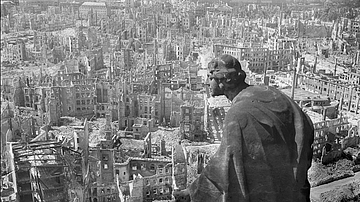
The Bombing of Dresden in 1945
The bomber raid on Dresden was a controversial and highly destructive combined operation by Royal Air Force Lancaster bombers and United States Air Force B-17 Flying Fortress bombers on 13, 14, and 15 February and 2 March 1945. The raid was...

Article
William Harvey's Discovery of Blood Circulation
The human body's system of blood circulation was discovered by the English physician and anatomist William Harvey (1578-1657) in 1628. Harvey determined the relationship between the blood system of arteries and veins and the regular contractions...
